A Printable Reader's Guide to Cannery Row
The Wild Gentleman Book Club
This printable reader's guide is designed for use at our monthly The Wild Gentleman Book Club meetings. Print it, bring it, and use it to spark conversation. For a full exploration of themes and context, see our complete Reader's Guide to Cannery Row.
Key Themes for Discussion
- Doc as the Model of the Good Man
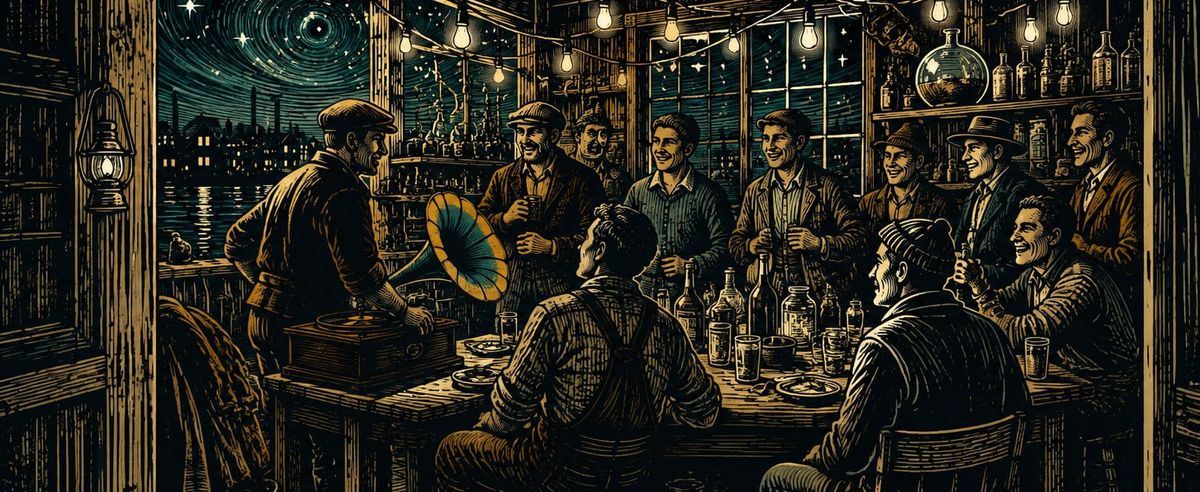
Doc lives life by his own terms, and, by doing so, he garners respect and creates goodwill among all whom he comes in contact with. The result is a yearning from the folks of Cannery Row to thank him, via a party, for his years of showing up as a good man.
- A Good Man for His Time?
Doc drinks heavily. Doesn't share all his ideas on how others can improve. He leaves a character in jail destined for a mental institute. He moves through relationships with women in a way the book treats as cavalier but could be viewed differently by modern readers. He's also, by the standards of Depression-era Cannery Row, remarkably decent — faithful to his friends, generous with his money and time, gentle with people everyone else had given up on.
- The Parts of the Book We Don't Get to Skip
Cannery Row was written in 1945 about a town in the 1930s, and it carries the casual racism and unexamined misogyny of both eras — the way Lee Chong is drawn, the way women largely exist in the book as objects of desire or figures of comedy, rarely as full people with interior lives. How dow we reckon with that?
- A Book That Just Comes to Be
Steinbeck opens Cannery Row by comparing the writing of it to collecting delicate marine animals: "you must let them ooze and crawl of their own will onto a knife blade... and perhaps that might be the way to write this book — to open the page and let the stories crawl in by themselves." The result is a novel that lacks structure — chapters on the town giving way to entire interludes about a gopher, or a some boys teasing one aonther, or a man who can't finish his boat, before returning to the main plot. Does it work or make it harder to read?
Questions for Discussion
- What specifically does Doc do for the folks on Cannery Row that earns their loyalty? Is it any one act, or is it the accumulation of small, unglamorous ones?
- Is it fair to hold Doc to a 2026 standard of what a good man looks like, or does that misread the book entirely?
- Steinbeck doesn't moralize about Doc's drinking or his women. Is that an endorsement, an oversight, or just honest reporting of the world as it was?
- Doc was modeled on Ed Ricketts, a real man Steinbeck considered one of the great minds he ever knew. Does knowing Doc is drawn from an actual friendship change how generously you read his flaws? Should it?
- Can a man be genuinely good — generous, present, loyal — while also carrying habits we'd now call self-destructive or unfair to the people around him?
- How do you read a book you admire — and one that is beautifully written — when parts of it are genuinely uncomfortable by today's standards?
- Whose story does Steinbeck actually tell in this book, and whose does he leave flat?
- What do we do with books like this as fathers, as men trying to pass along a reading life to the next generation? Do we hand them over with caveats, wait until kids are older, or trust readers to have the maturity to understand nuance?
- Does Steinbeck's stated approach — let the stories crawl in on their own — earn the loose structure of the book, or is it a clever excuse for a novel that doesn't quite hang together? Did you find the interludes to be helpful or meandering?
- Is Steinbeck arguing that attention to a place and its people itself a kind of story?
- Doc never seems to be performing goodness — he's not doing it to be seen as good. Does that matter?
- Self-sufficiency shows up again and again in Doc's character — his business, his solitude, his refusal to need much. Is that self-sufficiency the source of his generosity, or in tension with it?