A Printable Reader's Guide to Theo of Golden
The Wild Gentleman Book Club
This printable reader's guide is designed for use at The Wild Gentleman Book Club meetings. Print it, bring it, and use it to spark conversation. For a full exploration of themes and context, see our complete Reader's Guide to Allen Levi's Theo of Golden.
Key Themes for Discussion
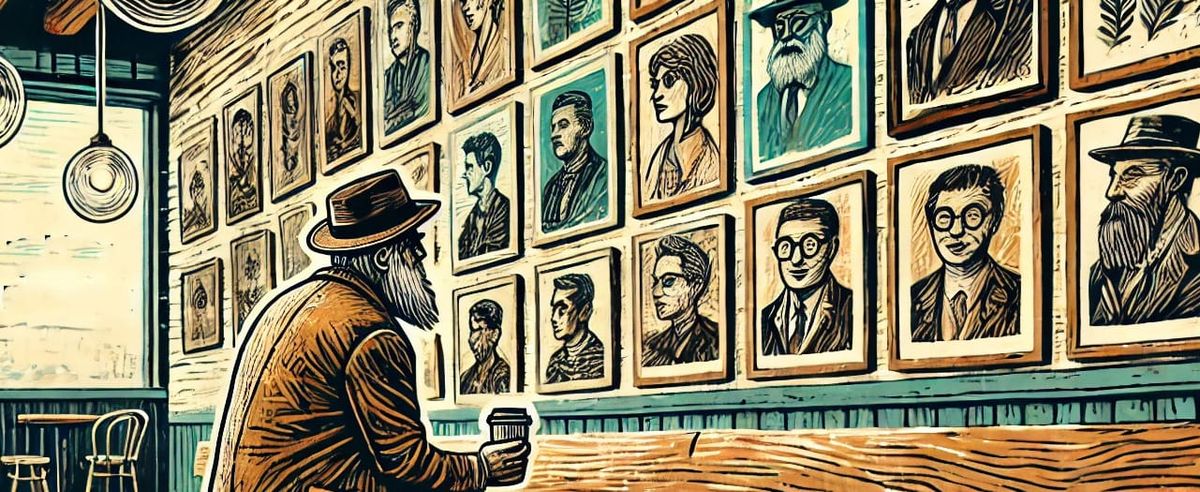
The main character in the book, Theo, takes it upon himself to return pieces of art he finds in a small coffee shop in the small town of Golden, Georgia, to their rightful owners. With each gift offering, more than a portrait is shared; stories, a piece of art, and a moment to be seen, recognized, and appreciated are all part of each bestowal.
Theo doesn't have a system. He doesn't optimize for getting all the pictures to their owners. He shows up, sits down, and listens intently. Quite the radical act in our world. And, he makes his own life and the lives of all the connections with him better for it.
- Presence as an Act of Love
Theo insists on showing up in person for every bestowal. He doesn't mail the portraits. He doesn't text. He writes by hand. He meets at the fountain. In a world that runs on convenience and efficiency, what does it mean to insist on presence?
- The Creative Act as Gift
Asher makes the portraits. Theo transforms them into something more by returning them to their subjects. Who is the artist here? What is the relationship between making something and giving it away?
- Generosity Without Recognition
Theo operates without needing to be known. He's a famous, reclusive artist — and he spends his time in Golden as nobody, asking nothing for himself. What does it take to give without wanting credit? Is that even possible?
- Bettering Others as a Way of Bettering Yourself
Theo's interventions seem to improve his own life as much as the lives of the people he touches. There's a question worth sitting with: When we show up generously for others, are we being selfless — or are we, at some level, doing it for ourselves? Does it matter?
- Sadness and Beauty as Companions
Theo speaks about "good sadness" — the sadness in Asher's portraits, which he sees not as a flaw but as the universal affliction, the longing that makes great love possible. What's the difference between sadness that diminishes and sadness that deepens? Is this beautiful sadness a key part of all great art?
Reading Questions
- When you first meet Theo, what do you make of him? Is he believable as a human being — or does he feel more like a figure, an archetype, an idea given a name? Does that distinction matter to you as a reader?
- Theo keeps his identity — his fame, his history, his art — entirely private while he's in Golden. Why might a man who has achieved so much choose to be nobody? What does anonymity give him that recognition couldn't?
- Think about the way Theo initiates each bestowal: the handwritten invitation, the arranged meeting, the personal exchange. What is he protecting by insisting on this process? What would be lost if he just left the portraits at people's doorsteps?
- Asher created the portraits without knowing what Theo would do with them. Does that change what the portraits mean? Who do the portraits belong to — the artist who made them, the man who bought them, or the people depicted in them?
- The creative process is woven through this book in an unusual way. The portraits aren't discussed as art objects — they're discussed as acts of attention. Asher paid attention to people's faces long enough to draw them. Theo paid attention to the portraits long enough to know who needed them. What does this suggest about the connection between attention and creation?
- At its core, what Theo gives each person is their own story — their own likeness, their proof of having been seen. Why is being seen so powerful? Think about a time someone really saw you. What did that person do, or not do, that made it feel different from ordinary attention?
- Theo is later revealed to be a famous artist — someone whose work has value far beyond what anyone in Golden knew. Does that revelation change how you feel about what he was doing there? Does it make his generosity larger, or does it complicate it?
- The novel suggests that in the act of giving to others, Theo is also completing something in himself. Do you believe that? Is there a kind of generosity that is truly selfless — or is giving always, at some level, a way of becoming more fully who we are?
- Before Theo arrived in Golden, he was famous and reclusive. After Golden, he is unknown and deeply connected. Which version of him seems happier? Which version seems more alive? And what does your answer say about what you value?
- If Theo had lived, what do you think he would have done next? Does the story feel complete to you — or does his death feel like a theft?
Printable Reader's Guide