A Reader's Guide for A Christmas Carol
The Wild Gentleman Book Club
Key Themes for Discussion
The Business of Being Human
Early in the story, Scrooge declares, "It's enough for a man to understand his own business, and not to interfere with other people's. Mine occupies me constantly."
But Marley's ghost returns to tell him: "Mankind was my business. The common welfare was my business; charity, mercy, forbearance, and benevolence were all my business."
Questions to explore:
- How do we define our "business" as men? It seems, with the hindsight of being dead for seven years have given Marley a different definition than he held in life.
- Do we, or have we, sometimes used the excuses of "I'm busy" or "work is demanding" to shield ourselves from moments when we might become vulnerable and make a greater impact on our partners, colleagues, friends, and families?
The Light We Try to Extinguish
In one of the book's most powerful metaphors, Scrooge tries to use the cap to cover the bright light shining from the Ghost of Christmas Past. The ghost responds: "What! Would you so soon put out, with worldly hands, the light I give?"
Dickens suggests that we've built the very cap that dims our own light—that is, the value of memory, feeling, connection, and, especially from childhood, our naiveté.
Questions to explore:
- Scrooge, as a child, loved stories and imagination—and yet, this seems wholly absent in his life as an adult. Did this scene make you reflect on things you may have lost over time due to a need to be practical?
The Power of Small Acts
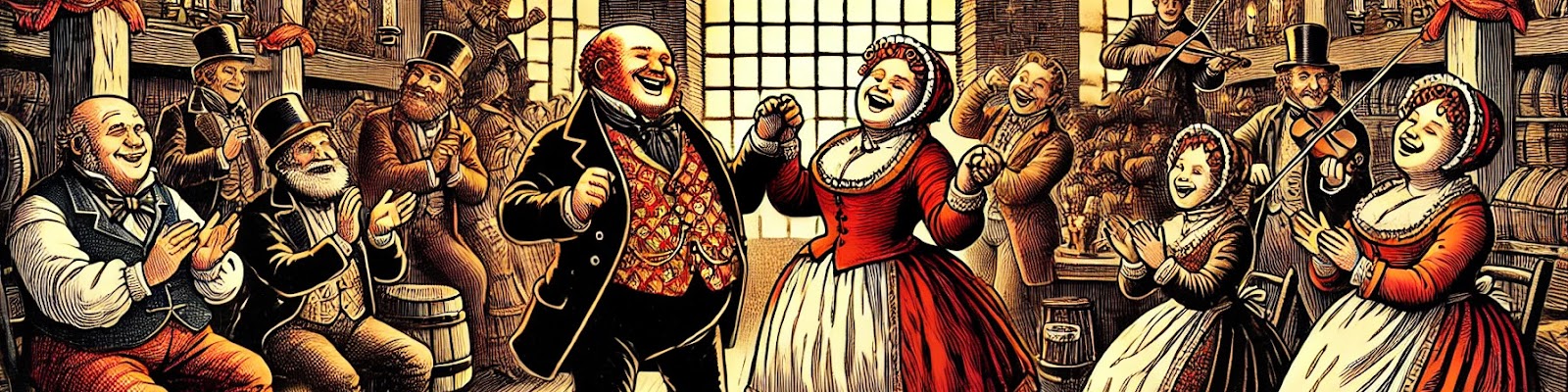
The Fezziwig scene is crucial. After watching his former master create joy through a simple Christmas party, Scrooge reflects on power: Fezziwig "has the power to render us happy or unhappy..."
This is a revolutionary definition of masculine power—not dominance, but the ability to create conditions for others' flourishing.
Questions to explore:
- Where do you have Fezziwig's kind of power—as a father, partner, boss, mentor?
- What "slight and insignificant" acts could you commit to that you have ignored?
- Who created joy for you the way Fezziwig did for young Scrooge?
Presence Beyond Circumstances
The scene at the Cratchits is remarkable for its joy despite poverty. Bob Cratchit has every reason to be bitter—low wages, a sick child, precarious circumstances. Yet Dickens shows us a family rich in what matters: Family, laughter, and love.
Even more striking: When Bob toasts Scrooge, the family's joy isn't thoroughly dampened. They refuse to let resentment ruin their celebration.
Questions to explore:
- How much of your happiness do you make conditional on circumstances improving?
- Are you waiting to be happy until you achieve X, Y, or Z?
Laughter as Resistance
At his nephew's house, Scrooge witnesses something he'd dismissed as foolishness: unrestrained joy. Dickens writes: "There is nothing in the world so irresistibly contagious as laughter and good humor."
For many men, especially as we age, laughter becomes something we've lost. We become too serious, too focused.
Questions to explore:
- Who in your life is like Scrooge's nephew—stubbornly joyful despite your resistance?
Ignorance and Want: The Children We Create
Near the end, the Ghost of Christmas Present reveals two wretched children hidden under his robe: Ignorance and Want. "They are Man's," the ghost says. "And they cling to me, appealing from their fathers."
This haunting image suggests we create these conditions through our choices—through what we ignore, through the wants we fail to address.
Questions to explore:
- The ghost says "beware them both, and all of their degree, but most of all beware this boy [Ignorance]"—why is ignorance more dangerous than want?
Reading Questions
About Scrooge:
- I found myself asking if, at any point, I empathize with Scrooge? I found it notable that Dickens established this unlikeable man as the "hero."
- At any point in the story did your feelings about Scrooge shift?
- Is he admirable in any way? (Consider: he's competent, self-reliant, not a hypocrite about his values)
- What would it take for you to change as dramatically as Scrooge does?
About the Ghosts:
- Which ghost's visit affected you most?
- Why does Scrooge need to see past, present, AND future?
About Application to Life:
- What is Dickens saying about memory and its role in who we become?
- Scrooge wakes up with time remaining. What would you do differently if you woke up tomorrow with "time before you"?
About Masculinity:
- Scrooge, Bob Cratchit, Fezziwig, the nephew, and Marley represent different models of manhood. Which resonates? Which repels?
- What does Dickens suggest makes a man "good"?
- How does vulnerability (Scrooge's tears, his breaking down) relate to his transformation?
About the Writing:
- Dickens's prose is remarkably visual and emotional. What passages struck you? For me, each description of the ghost was remarkable.
- How does he make the supernatural feel real and urgent?
- The book balances darkness (Ignorance, Want, death) with joy. How does he manage this?
Printable PDF