Newsletter #7 - Beginnings and Endings


Updates
We have our sixth in-person meeting of The Wild Gentleman Book Club scheduled for Tuesday, January 20, at 6 PM at Paddy's Public House in Newton.
The book club selection for January is Mary Shelley's Frankenstein—a book I finally read after years of false starts. The focus on the responsibilities of man and on how ambition can blind us to moral clarity is as relevant today as it was in Mary Shelley's day, when mechanical technologies were just emerging.
If you're planning to join us, RSVP here: https://luma.com/dzmi4g1i
As we begin a new year, I find myself thinking about legacy — not in some abstract, posthumous sense, but in the everyday choices that define who we are. More on that below.
If you have suggestions for books that explore themes of character, purpose, and what it means to be a good man, send them my way at dennis@thewildgentleman.com.
Read on.
The Wild Gentleman Book Club
Tuesday, January 20 | 6:00 PM | Paddy's Public House, Newton Discussion of Frankenstein by Mary Shelley
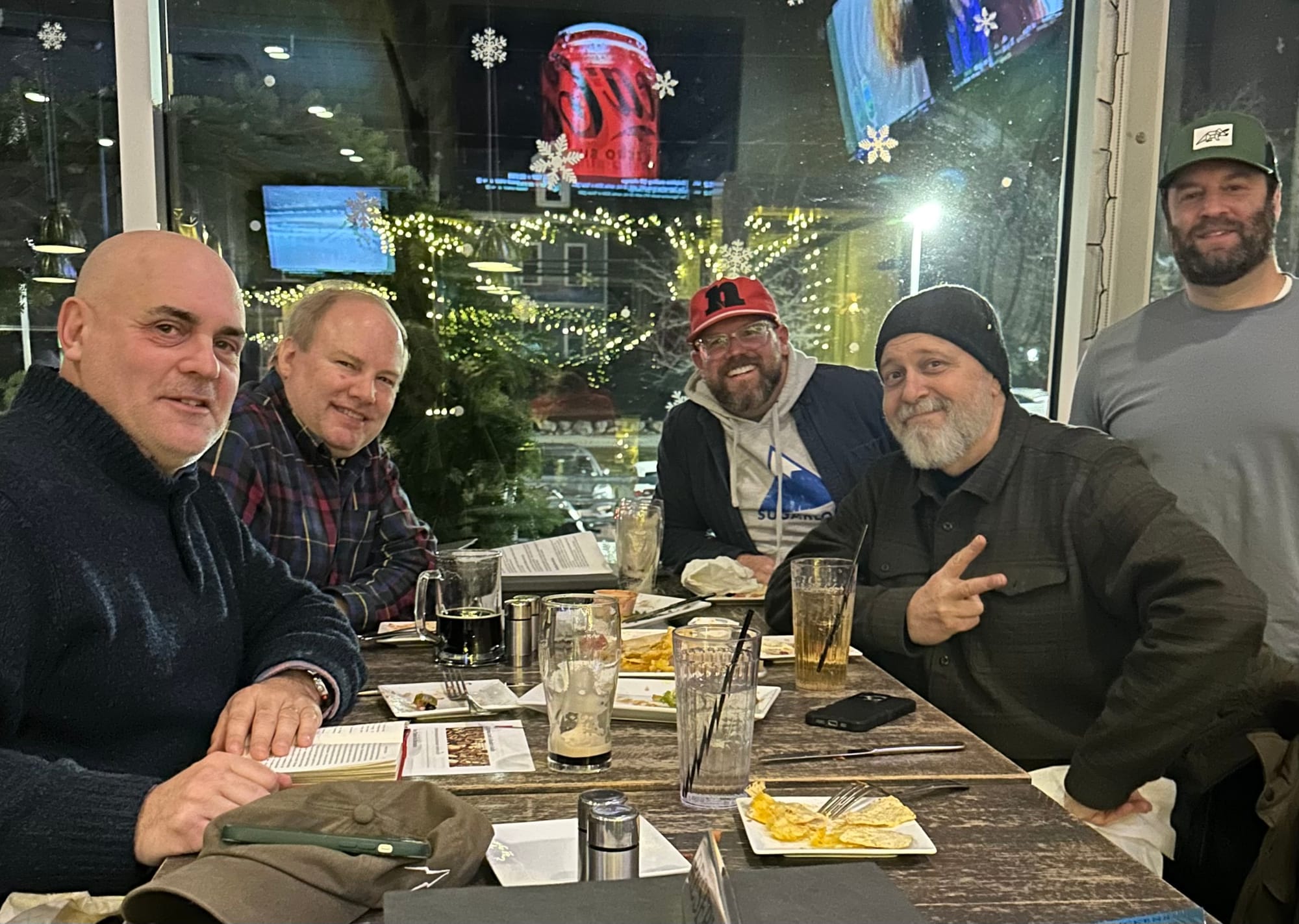
The book club is open to anyone interested in discussing life and books, or simply connecting with other thoughtful men. We had a great gathering in December in Waltham, but we will be returning to Paddy's Public House in West Newton again this month.
Our conversation last month was rich and, at times, quite challenging. I think we all walked away with new perspectives, thanks to the insights shared by everyone who came and opened up their compelling personal histories.
This month's selection feels particularly timely. Frankenstein asks fundamental questions about what we create and what we owe to our creations—whether that's our work, our relationships, and more.
Victor Frankenstein's failure wasn't in creating something new. It was in abandoning his creation out of fear and disgust. How often do we do the same? Start projects we don't finish? Build relationships we don't maintain? Begin challenges that we don't see through?
Even if you haven't finished the book, join us. The audiobook is excellent and widely available on Audible and Spotify. These gatherings continue to be one of the highlights of our months — thoughtful conversation, genuine connection, and the kind of dialogue that makes us better men.
Please RSVP here: https://luma.com/dzmi4g1i
On Bob Weir and What It Means to Live Well
Last weekend, longtime Grateful Dead guitarist and songwriter Bob Weir passed away.
I know the Grateful Dead aren't everyone's jam, but I grew up listening to the Dead, mostly after Jerry Garcia passed away, so Bob Weir was an ever-present figure in my life. Weir, who helped form the band as a teenager in San Francisco, is a bit of an enigmatic figure. Starting as the prank-loving kid brother of the Dead and evolving to the elder statesman of a massively influential cultural phenomenon, Weir lived a long, eclectic life. For me, the example of how Weir carried himself as he aged, the life he built and family he surrounded himself with, his philosophical explorations, and his openness to share both his successes and failings as a man, make him a true wild gentleman.
Weir wasn't just a musician. He was a poet, a storyteller, and someone who seemed to understand something essential: Live with authenticity, generosity, and the flexibility to change while seeking that elusive "life-well-lived."
The Weight of that Life Well-Lived
There's a particular kind of grief that comes with losing someone who modeled a different way of being a man. Not the stoic, emotionally distant archetype. Not the chest-beating rock star (at least most of the time). Bob was a man who showed us that strength and sensitivity aren't opposing forces—they're complementary.
Weir's lyrics were filled with contradictions: Wild and philosophical, celebratory and melancholic, rooted in tradition while constantly pushing forward. He could write about outlaws and lovers, about loss and renewal, about the search for the elusive mythical American landscape and the interior landscape of one's heart—sometimes within the same song.
For me, Bob exemplified a uniquely American spirituality borne through his unique life experiences. At the western edge of the American continent, a midpoint between the East of China and Japan and the East of New York City, San Francisco was the center for twentieth-century mindfulness, drug exploration, creativity, and art. It is no coincidence that California's north-west port city gave us the Dead, Steinbeck, Apple Computers, Jack London, the Acid Tests, City Light Books, robust Asian and Latin food amalgamations, and more.
Weir participated in the Acid Tests but eschewed LSD quickly and embraced a personal approach to sobriety that made sense for him later in life. He also became a avid yoga and workout participant and promoted the benefits of meditation. He also never hid from the missteps he made in life, as far as I understand his story.
For Weir, the path to being a good man was simple: Keep creating. Keep showing up. Keep being present for the people around you.
How Weir Dealt With Loss
In an interview with Andy Cohen on Watch What Happens Live, Weir was asked about how he dealt with the loss of Jerry Garcia. His answer reveals something profound about how he approached grief and continuity:
"I tell you what, I'm not sure if I ever did," Weir said. "I was just wondering about that. I think, what I did, 'What am I gonna do? I'm gonna hit the road, that's what Jerry would've wanted me to do.' And I did, I stayed on the road for a long time after Jerry checked out. And you know, by the time I finally came home, and my wounds were all licked, I was okay."
"I guess I processed the grief to a greater extent than not just by playing."
In the same interview, Anderson Cooper, also there as a guest to promote his own project on death and grief, suggested that Jerry became the music Bob continues performing. Weir agreed: "Every bit. I found him there; I could hear him in the back of my head. I could feel him, 'Don't go there, don't go there, agh! Okay, if you gotta go there, then don't do that.' It was our relationship that never changed much."
Then Weir said something that challenges how many of us think about loss: "I gotta say, I don't grieve all that ferociously about anybody's passing. I had two sets of parents, and they're all gone now. And all the rest of both my families grieved heavily, some of them grieved heavily, and I just don't do that. I just carry them with me."
Whether or not you share Weir's spiritual beliefs, there's wisdom in his approach: Grief is transformed into something generative. He carried the people he loved forward through his creative work and his presence in others' lives.
Weir's approach to loss also makes me think about time itself and the necessity to fill our lives with meaning by how we show up and what we carry forward.
What Beginnings and Endings Teach Us
January is the month the powers that be (aka corporations) tell us to think about new beginnings—resolutions, fresh starts, reinvention. But here's what the past week (in which I also lost a family friend who also lived a life in the service of others) has reminded me: When thinking about beginnings, we must also reflect on endings.
This is innate in all we do as men. We write, we build relationships, we raise children, we form communities—all against the backdrop of our own impermanence.
I don't mean to be morbid. But thinking of beginnings and endings can be clarifying.
The writers that I love who shared what I will call Weir's "cosmic itch" understood this intuitively. Kerouac hit the road searching for something he didn't understand (America? maybe), finding meaning in the journey itself. Steinbeck found dignity persisting in the common man's plight to survive. These are kindred spirits to Bob Weir.
Like Weir, these writers understood that authenticity isn't about having all the answers. It's about staying on the road, staying present, staying open to what you can imbibe from the journey.
This month's reading selection, Frankenstein, is a story fundamentally about creation and the uncertainty that can arise if the imaginative side of our being has no guardrails. But it is a deep exploration into legacy and impermanence.
What are we creating? What are we abandoning? What will we leave behind?
Moving Forward
The beautiful thing about literature is that it gives us language for these experiences. It shows us that our questions aren't unique — they're universal. That our struggles aren't signs of failure — they're signs of being human. (This is also something that comes up in The New York Times interview with George Saunders linked below.)
The specific books we read as part of The Wild Gentleman Book Club don't really matter as much as the opportunity for us as a community of men to come together and ask hard questions. Sometimes these are about supporting each other in living more intentionally, other times it is about how often we think about our own mortality. My favorite part of the growing book meetups is the sense that there is some real, innate wisdom being passed on.
I was lucky to hear Bob Weir sing The Grateful Dead song "Ripple," in person on a few occasions. The song was written by Robert Hunter and Jerry Garcia, and was a Garcia staple. After Jerry passed away, Bob took over this song, which carried greater significance and weight as he aged. (This past weekend, at a memorial service in San Francisco, Weir's Dead & Company bandmate John Mayer gave his rendition in tribute.)
At the end of the day, the poignancy of the song is one that Weir carried on from Garcia, which we can all carry into our lives. Sometimes, you've got to go it alone and see what happens. But the irony of the words and the song, in particular, is that it is a communal experience, almost a sacrament, sung in concert halls or small dive bars. The singer belts out the words, and we all join in in harmony.
"There is a road, no simple highway
Between the dawn and the dark of night
And if you go, no one may follow
That path is for your steps alone."
Bob Weir understood something essential: Life begins. Life ends. But day-to-day, it keeps moving. The question is whether we're playing our part with authenticity, with care, with attention to what matters. We can do it alone. And we often do. But, quietly, and even better. We are all making ripples in each other's lives.
Rest in peace, Bob. Thanks for showing us a different way.
The Gentleman Shares - Recent Thought-Provoking Reading
"George Saunders Says Ditching These Three Delusions Can Save You" - David Marchese, The New York Times
Our November book club selection was George Saunders's A Swim in a Pond in the Rain. In this Times interview, the author explains three fundamental delusions we all carry: That we're the star of the show, that we're not going to die, and that we're separate from everyone else.
Saunders frames confronting these delusions not as depressing, but as "a reality check" that's ultimately joyful. This ties directly into the exploration of beginnings and endings; specifically, the responsibility that comes with recognizing our connection to others and the limited time we have.
Particularly poignant: "Death is the moment when somebody comes and says: You know those three things that you've always thought of? They're not true. You're not permanent, you're not the most important thing, and you're not separate."
"The secret to being happy in 2026? It's far, far simpler than you think …" - Oliver Burkeman, The Guardian
Burkeman's bold proposition for taking on the new year: Stop trying to optimize yourself and instead spend more time doing what you actually want to do.
"This should be the year you stop trying so hard to turn yourself into a better person, and focus instead on actually leading a more absorbing life." A perfect reality check and reminder to be cognizant of how we spend our limited time.
The Best Books of 2025 - The New Yorker
I found a bunch of good potential "next reads" on this list as well as a few books to gift to people who I know will appreciate them. "Best of" lists are pretty great for pure curation and bringing art into your life that you may have missed.
How to Help The Wild Gentleman
Keep sharing ideas, book recommendations, blog topics, and feedback to dennis@thewildgentleman.com
Spread the word! If The Wild Gentleman resonates with you, share it with other men who might benefit. Here's the signup link: The Wild Gentleman Newsletter.
The community we're building depends on thoughtful people willing to engage deeply. If that describes you (and I think it does), help us grow.
Until next month—keep reading and keep showing up for the people and things that matter.
Wild at Heart. Refined in Mind.
Dennis