Newsletter #8 - In This Together

Updates
We have our seventh in-person meeting of The Wild Gentleman Book Club scheduled for tonight, Tuesday, February 17, at 6 PM at Paddy's Public House in Newton.
The book club selection for February is Daniel Quinn's Ishmael—a philosophical story about a gorilla who teaches a man on a search for wisdom, different perspectives on civilization, progress, and humanity's place in the world. It's weird, challenging, and exactly the kind of book that generates the conversations we enjoy.
If you want to join us, RSVP here: https://luma.com/dzmi4g1i
As we move deeper into the new year, I find myself thinking about community—not the LinkedIn kind, but the real kind. The kind where you can show up as yourself, ask hard questions, and leave feeling less alone.
If you have suggestions for books that explore themes of character, purpose, and what it means to be a good man, send them my way at dennis@thewildgentleman.com.
Read on.
The Wild Gentleman in January...
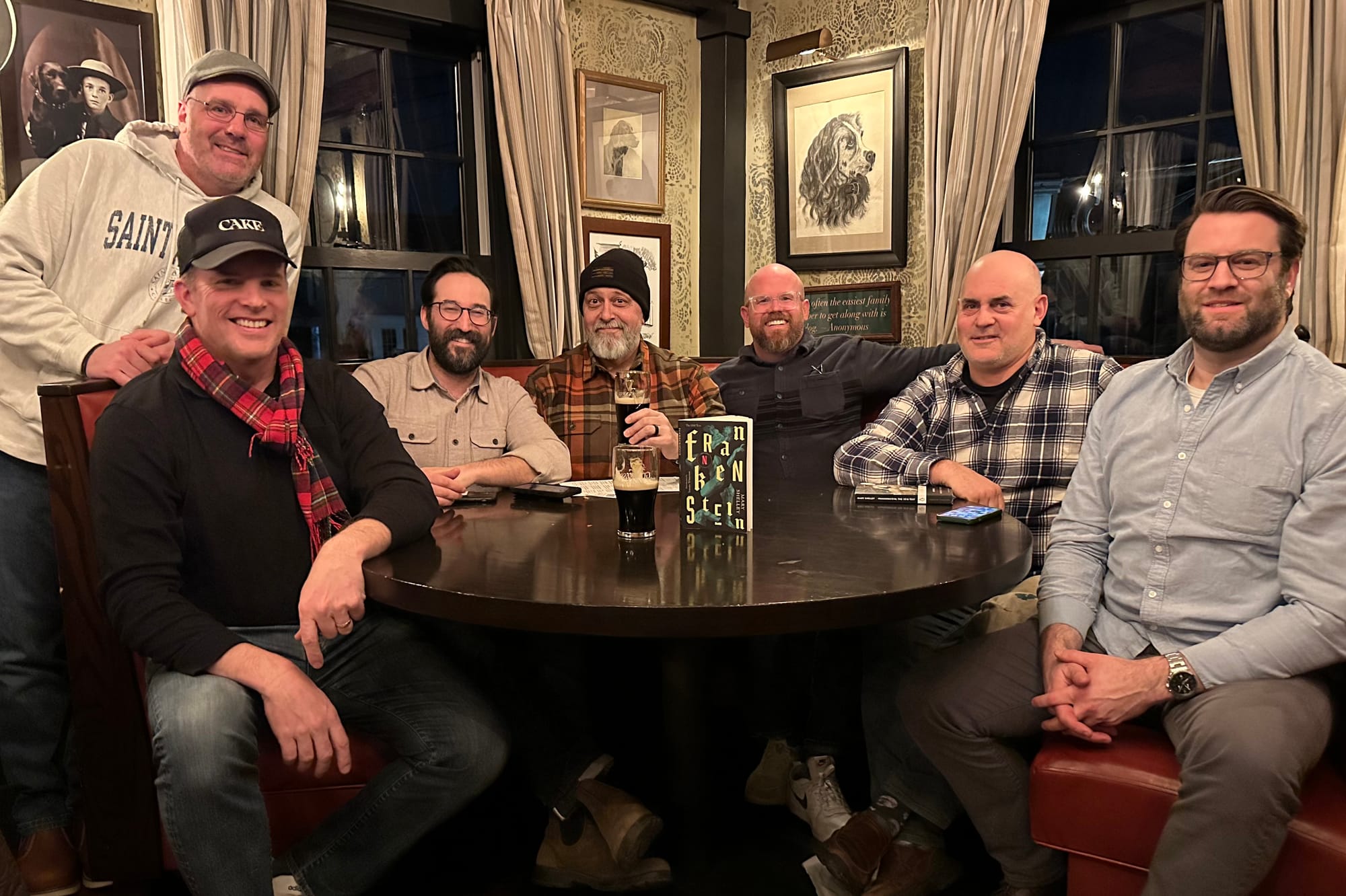
The book club is open to anyone interested in discussing life and books, or simply connecting with other thoughtful men. Last month we had a fascinating discussion of Mary Shelley's Frankenstein at Paddy's, and I'm still thinking about some of the insights that emerged.
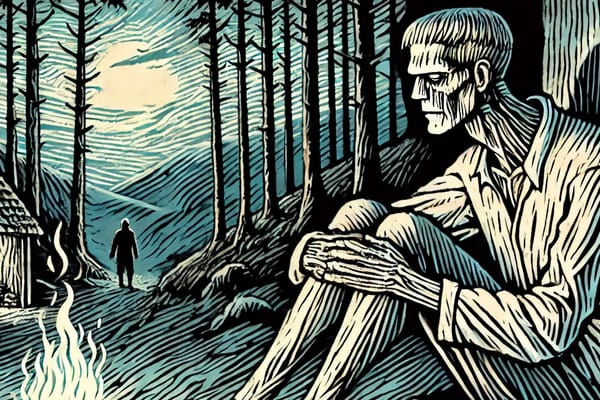
There was a lot of talk focused on men and the responsibility we have for the things we put out in the world. There was also a strong focus on the creature's profound sadness and horror as he searched for belonging and reflected on his sense of isolation despite being surrounded by people.
The creature's search for belonging, despite being surrounded by people, resonated with many of us. Because that's the paradox of male friendship in middle age—you can have a full calendar, a solid career, a great family, and still feel profoundly alone.
These are the conversations that make this worth doing.
We discussed which book to read next and selected Ishmael, which further challenges existing assumptions. Quinn's gorilla-teacher asks us to examine the cultural mythology we've inherited about progress, success, and what it means to be a man in modern civilization. It is a book that generates the kind of thinking we need.
On Making New Friends (in Middle Age)
I've talked about the worrisome implications for lonely men as they age here before (check out earlier posts: "Against Camaraderie" and "In Search of a Mentor"). The data shows that men have fewer close friendships, which also seems to impact higher rates of depression, anxiety, and health problems for men. We're lonelier, more isolated, and increasingly unsure how to fix it.
Making new friends as an adult is not easy and can often be awkward.
As younger men, friendships happened naturally because you were usually cast together with others who were like-minded—proximity created connection, whether through living nearby, being on the same team, or working at the same organization.
In your forties and fifties, you're settled. Established. Your calendar is full. Your social circle is mostly sorted. And the infrastructure that created friendship—forced proximity, shared struggle, unstructured time—is gone.
But the need for male friendship? That hasn't gone anywhere.
Why This Happens
Men's friendships decline sharply after marriage and the birth of children. By middle age, many men have no close friends outside of their spouse—no one to call when they're struggling, no one to share victories with, no one to tell them when they're being an idiot.
We learned to network. We're great at professional relationships, transactional connections, and friendly acquaintances. But actual friendship?
That's rare.
Also, we older men feel shame deeply; admitting the need for friends feels like admitting failure.
So what happens? We don't talk to others. We suffer quietly. We tell ourselves we're too busy for friendships.
What I'm Learning
I've been thinking about this a lot, partly because I'm living it. The Wild Gentleman Book Club started as an experiment: Could a gathering focused on something meaningful bring a bunch of guys together in real life? Could we build a community?
The books give us something to talk about, frameworks for thinking. But the real value isn't literary chatter.
It's the space we share where we can think out loud without fear or shame. And, to me, there are real bonds being built.
Here's what I've learned thus far about making friends later in life as we meet again for the book club:
Structure over spontaneity
You're not going to spontaneously befriend someone at this age. You need a reason to show up repeatedly. The book club works. There are also hobby clubs, volunteer organizations, recreational sports—anything with regular, scheduled time to talk with others.
Friendship requires repeated, unplanned interaction. You need to see someone multiple times in a context where you're not performing or selling, where you can be yourself. And some structure creates that opportunity.
Shared purpose matters more than shared interests
You don't need to find guys who like exactly what you like. I love this about the get-togethers we've had thus far: We all come from different backgrounds, yet we trust each other to be open, wrong, or vulnerable.
The book club members don't all have the same taste in books. But we all care about living thoughtfully. That shared value creates a real connection.
Embracing the awkwardness
The first few conversations will be weird. You'll feel like you're trying too hard. You'll wonder if anyone actually wants to be there. You'll question whether it's worth the effort.
But then you realize that everyone else is feeling the same.
The vulnerability required to make new friends is the same vulnerability that creates depth in existing friendships. You have to show up as yourself, not as someone you think everyone wants you to be.
The 200-hour truth
Researcher Jeffrey Hall suggests it takes 40-60 hours to form a casual friendship, 80-100 hours to transition to being a friend, and 200+ hours to become close friends.
You're not going to become best friends right away. But if you show up consistently, if you engage honestly, if you create space for others to do the same—friendship emerges.
The Courage to Reach Out
Making new friends at 47 requires risking rejection. You have to be willing to try something that might not work.
That's hard. Especially when there is a cultural impression that men who need others are weak, that we should be self-sufficient, and that real men don't require connection.
But that's nonsense.
The best men I know—the ones who are genuinely happy and who live with purpose—have great friendships. They have people who know them well or communities where they can be vulnerable without losing respect.
Here's what I'm learning: The same qualities that make you a good father, a good partner, a good professional—showing up consistently, being honest about your limitations, caring about others' growth—are exactly what create real friendship.
I don't have this figured out. I'm writing this as someone who is in a very unsure place in my life with friends, career, family, and more.
So here's my challenge—to myself and to you:
- Reach out to that guy you keep meaning to text.
- Say yes to the invitation you'd normally decline.
- Start something—a book club, a pickleball game, a running group—even if you're not sure anyone will come.
The worst that happens? It won't work. You feel awkward for a bit. You move on.
The alternative is that you build exactly the kind of community you've been missing.
It isn't easy for grown men to make friends.
That's the work. And it's worth doing.
The Gentleman Shares - Recent Thought-Provoking Reading
"Virtus #069: The Friends Men Stopped Making" - Dragos Alexa, Menquilibrium
This post is related to the conversation about men and friendships. The author notes that in 2021, the share of men reporting no friends quintupled to 15% from 3% in 1990.
Alexa blames the lack of community options: No more bowling leagues, neighborhood bars, church halls, and pickup basketball games. He then conducted what he calls a "friendship inventory," sorting men in his life into three categories: contacts, buddies (enjoyable for a beer), and real friends (built through years of showing up). He concludes that his real friends are much smaller than he had imagined.
"Role Models" - Scott Galloway, No Mercy/No Malice
Galloway: "Society grows great when old men plant trees whose shade they’ll never sit under.” There’s an inverse to that wisdom. Great societies decline when old men chop down forests meant to provide shade and oxygen for future generations."
Galloway argues that we're failing to provide role models—people to guide us and look up to. He points to Ben Franklin as "the prototype for an American inventor/entrepreneur" who "served as a role model to countless nineteenth-century business leaders."
How to Help The Wild Gentleman
Keep sharing ideas, book recommendations, blog topics, and feedback.
Spread the word!
If The Wild Gentleman resonates with you, share it with other men who might benefit. Here's the signup link: The Wild Gentleman Newsletter
Join us on February 17 or next month.
The community we're building depends on thoughtful people willing to engage deeply. If that describes you (and I think it does), help us grow.
Until next month—keep reading and keep showing up for the people and things that matter.
Wild at Heart. Refined in Mind.
Dennis