All the Pretty Horses - A Reader's Guide

Meeting #14 - Wednesday, September 23, 2026
The Wild Gentleman Book Club
Last month, we chatted about Charles Portis's True Grit. This month, we stay in the West (southwest) with Cormac McCarthy's All the Pretty Horses.
All the Pretty Horses Meeting Details
We will once again meet at 6:00 PM at Paddy's Public House in West Newton.
If you are interested in the growing The Wild Gentleman community, even if you haven't read the book, come tonight and share the good conversation and better company.
This month's book is Cormac McCarthy's All the Pretty Horses, the first in his Border Trilogy, which also includes The Crossing and Cities of the Plain.
All the Pretty Horses is also a great listen on both Audible and Spotify. All of us listen to audiobooks regularly, so if listening to a book is your jam, we are here for it.
Information and RSVP here: The Wild Gentleman Book Club - Meeting #14.
You can also get a printable version of this reading guide here: Printable Reading Guide.
What All the Pretty Horses Teaches Men
John Grady Cole is sixteen years old when he turns his back on the only world he has known in search of something that seems close but is also, almost mythically, unattainable. A place out of time. A legendary region in which he believes he, with his unmatched ability to break and train horses, will thrive.
And that all occurs within the first few pages of McCarthy's tale of young, naive cowboys in search of a destiny that doesn't exist in the land where they were born.
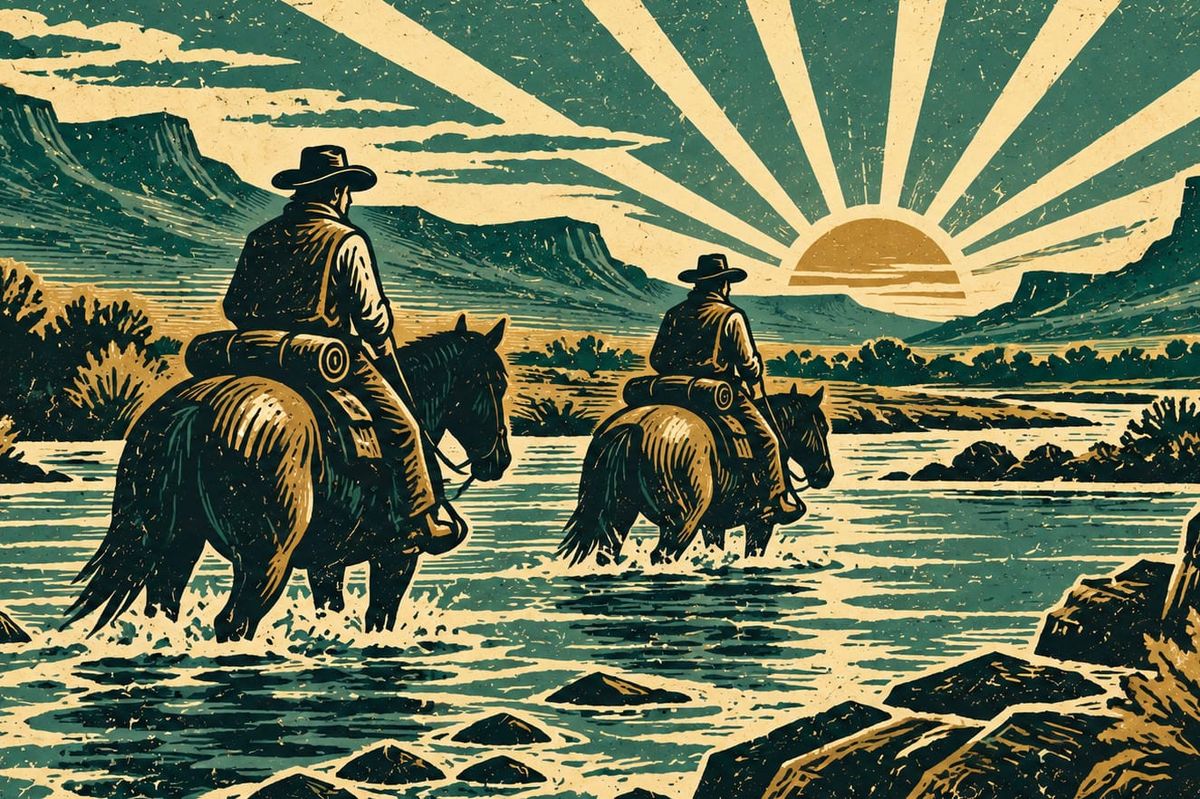
With his grandfather's death and the family ranch up to be sold, the future John Grady ever pictured for himself — running cattle and breaking horses on land that had been his family's for generations — is gone. So he does the only thing that makes sense: he saddles up with his friend Lacey Rawlins and rides south into Mexico, looking for a version of the cowboy life that has long disappeared from this modern world.
McCarthy is at his best in the book. His language, the descriptions of Texas plains and Mexican villages, all the startling word choice that somehow contains brevity — it's all enchanting.
And, he paints a deep, moving picture of John Grady simply: "What he loved in horses was what he loved in men, the blood and the heat of the blood that ran them. All his reverence and all his fondness and all the leanings of his life were for the ardenhearted and they would always be so and never be otherwise."
That sentence is not only the code John Grady operates by, but it is his essence. Not selfishness, not attention, not toughness for its own sake — an unwavering reverence for nature's creatures, human or animal.
Once McCarthy presents John Grady Cole and his modus operandi, he spends the rest of the book pressure-testing his approach: John Grady's honorable way of living.
He falls for Alejandra, the ranch owner's daughter, a line he knows better than to cross and crosses anyway. He and Rawlins end up in a Mexican prison over a horse that was never even theirs to begin with — picked up alongside Jimmy Blevins, the reckless youngster who hooked on to the duo for his own safety, not caring what the implications could be for John Grady and Lacey. In the chaos of the jail, John Grady kills a man to survive, which McCarthy refuses to paint as a victory.
And that is McCarthy's chilling gift: Balancing the intensely consequential line between life and death as mundane. John Grady's prison fight and survival is just a thing that happened, a frightening revelation from McCarthy: violence is untethered and beyond our sense of control. The killing is not clean, not earned, not something a sixteen-year-old should have needed to learn how to do.
Even then, John Grady has more painful lessons to undertake. Alejandra's great-aunt, Alfonsa, tells John Grady the truth nobody else in the book will. She's lived by convictions that led her to believe she deserved outcomes that matched her conviction. But that, she imparts to John Grady, is not how life works. She isn't cruel to him. She's precise.
John Grady rides home in the end, and home is gone as well — his father has died, the ranch is gone, and the America he left is exactly as unrecognizable as the Mexico he's leaving behind. He is not the same person who rode south.
But in the end, John Grady's story isn't about triumph or defeat. It's about a kid who has become a man doing the only thing he's ever actually known how to do. Ride.
Discussion Guide
1. The Code of the Unblemished Man
John Grady's code — upholding a reverence for love, loyalty and sincerity, a refusal to be otherwise — seems fully formed in the sixteen-year-old, even before the greatest adventure of his life. But that journey, as he travels south from Texas to Mexico, tests the resolve of a belief system that is both ardent and naive.
Most of us don't hold onto the principles (or lack thereof) we had at that age. Some of that change is called growing up. Some of it erodes. Through experience, we develop new codes.
Questions to explore:
- What's the piece of your own code — a rule, a conviction, a way you decided to be — that you still live by that you can trace to your twenties or before? What parts of your code from that era have disappeared?
- John Grady never explains or defends his code to anyone; he just embodies it. (It's also clear that Lacey inherently understands how Grady operates.) Where in your own life do you try to explain a conviction or belief instead of just living it?
- Is there a cost to being like John Grady — to holding a line the world has stopped rewarding? He loses friends, ends up in jail, and loses the girl, all of which can be traced to this unspoken moral code. Is the book arguing that the cost is worth paying, or is it showing how adherence to code can lead to a fall?
2. What Love Costs
John Grady seems to know better than to cross the boundary that exists just due to Alejandra's being — beyond the surface problems of two teenagers having a secretive, sexually charged affair, including a difference in class, in family, in what her world will tolerate. And yet, he breaks the unspoken rules anyway, without much deliberation or care. The weight of the relationship is revealed once Alfonsa later explains what that decision set in motion.
Questions to explore:
- Alfonsa tells John Grady, in effect, that sincerity doesn't prevent you from consequences, especially those you are blind to or cannot understand. Have you learned that lesson about a positive character quality that doesn't lead to a consequence you expected?
- John Grady never seems to weigh whether Alejandra is "worth it" before pursuing her. Is that recklessness, or is it the same quality that makes him admirable elsewhere in the book? Can it be both?
- Alfonsa gave up her own version of this fight decades earlier and lived to tell John Grady exactly what it cost. Have you had any figures like Alfonsa in your own life — someone who'd already paid for the lesson and tried to share the pain of the experience with you?
3. The Country That No Longer Exists
John Grady and Lacey (and maybe even Blevins) ride south chasing a version of the West that was already gone in Texas, and, he finds, may not be what it seems in Mexico. When he rides home, he finds the America he left is unrecognizable, as well. Nostalgia, it seems, isn't comfort — it's the thing that gets the kid imprisoned, nearly killed, and with infinite traumatic experiences that could fill the rest of his days.
Questions to explore:
- Is John Grady's ride south an act of courage, an act of denial at his life and lot, or both? Does the book let you land on one conclusion?
- What's the version of "the ranch" in your own life — the thing you were raised to expect that simply isn't there anymore, that you've had to decide whether to keep chasing or let go of?
- By the end, McCarthy suggests the world you're loyal to, and the world that actually exists, are rarely the same place. How do you tell the difference between holding onto something worth keeping and refusing to notice it's already gone?
One note: This book contains many passages in Spanish between Grady and others. Here is a resource if you are interested in translations of all these passages from All the Pretty Horses.
Final Thoughts
John Grady Cole never gets to return to the life he had when the book opens. The ranch is sold. Alejandra is gone. The friend who didn't make it home stays dead. And still, on the last page, he's back riding out on a horse into whatever's next, seemingly the same figure he was on the first page in the ways that actually matter.
The book is honest about the trade John Grady makes: Living by a code doesn't come cheap, and the world won't confirm that the way you live is right. It just means you're still you when your soul has been tested, and you come out on the other side, for whatever that turns out to be worth.
The Wild Gentleman Book Club
Where thoughtful men gather to explore literature, meaning, and authentic masculinity.
Wild at Heart. Refined in Mind.