Newsletter #16 - Home is Where


Updates
"It is impossible to care for each other more or differently than we care for the earth."
"The same natural forces that so threaten us are the same forces that preserve and renew us." - Wendell Berry, "The Body and the Earth"
Tonight is the next in-person meeting of The Wild Gentleman Book Club.
We're digging into our first work of non-fiction, Wendell Berry's The Unsettling of America: Culture and Agriculture. This book was a challenge but worth the effort. Although Mr. Berry died at the end of August, the work of — as well as enlightening stories about — the longtime Kentucky farmer and writer has been shared with renewed vigor from the likes of Barbara Kingsolver, Kara Swisher, and, of course, that great champion of all things Wendell Berry, Nick Offerman.
Never been to the book club before? Not to worry. Come for the good company. Even if your copy of the book is "still in the mail," no problem. There are always a few attendees who didn't even get past the front cover.
You can also listen to The Unsettling of America on Audible or Spotify.
The Wild Gentleman Book Club
Wednesday, October 21st at 6:00 PM
Paddy's Public House in West Newton
RSVP here: https://luma.com/6d6cyjj5
Questions? Reach me at dennis@thewildgentleman.com.
Read on.
The Wild Gentleman in September
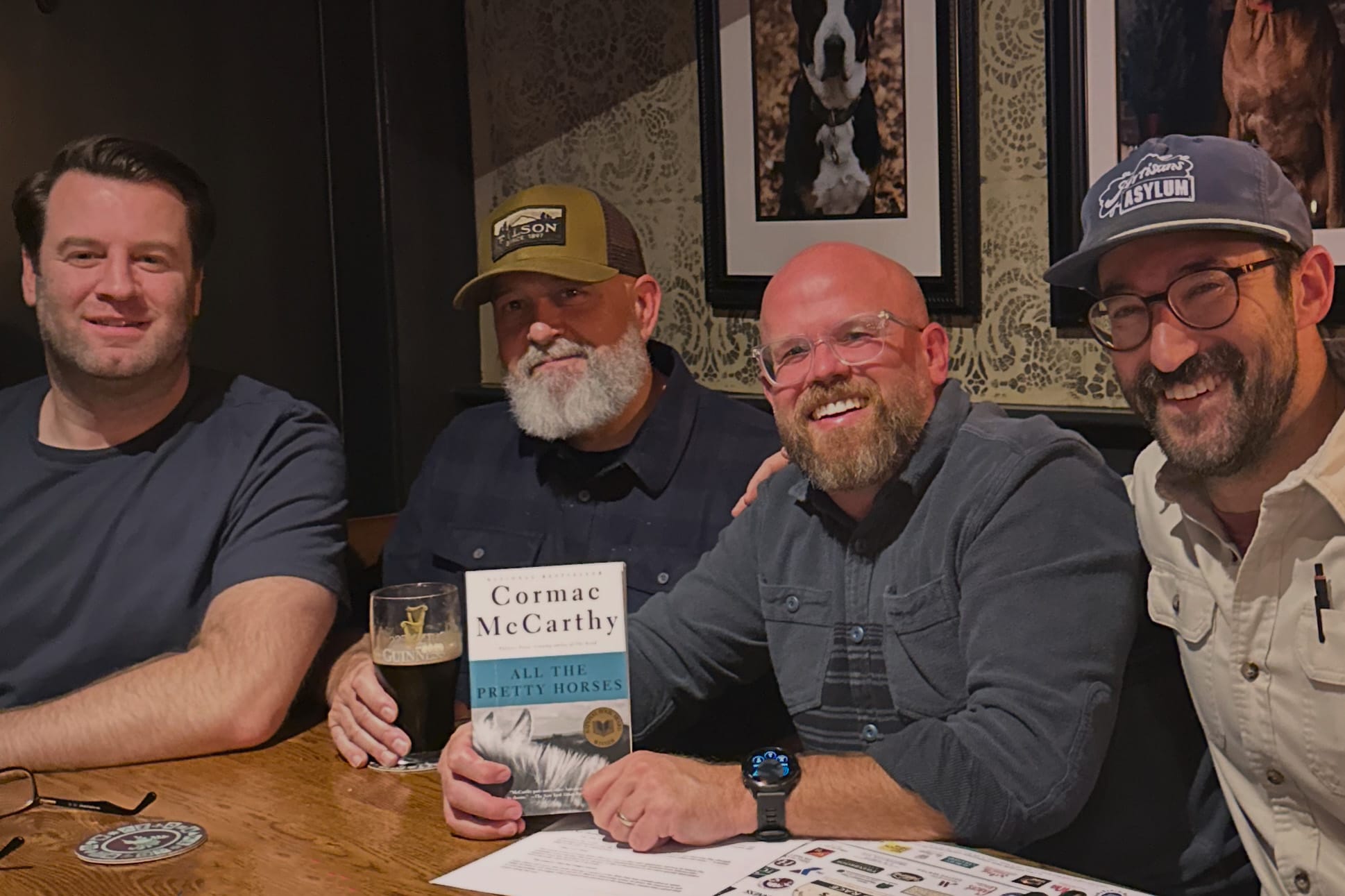
Our September book club met to discuss All the Pretty Horses — which some of us loved, and some found tedious. More broadly, we chatted about Cormac McCarthy, the artist, as well as the senses of brotherhood, duty, and, less flattering, the naïveté that leads the main characters to (mis)adventures in love and death in Mexico.
It was great to get together and catch up on life as summer began to turn into fall. With our busy lives, it is a comfort to have a consistent time and reason to get together. Even better if we talk about falling in love with beautiful, fictional Mexican women, handling responsibilities we didn't ask for, and the uncertain paths our lives can take.
For more on McCarthy, check out the All the Pretty Horses Reader's Guide here.
The Settled Man

"It must have been a nice day to work from home?" my wife said as we were walking the dog the other night. Without giving too much thought, I replied, "I guess so, I was really inside working and trying to get stuff done all day."
Instantly, she stopped, looked at me, and said, "I mean, it is a great, beautiful day! You are lucky to even have the backyard this time of year to look out to."
And, in a moment, the internal dialogue I was caught in about belonging and Berry's "unsettled" man melted away. She was right. Here I was trying to think through how to settle down and show up better for my entire family, to stay connected to my community and home, to find purpose, to slow down. And I didn't even take the simple action of stepping outside and being in the sublime nature that is presently surrounding us here in New England.
One of my great aspirations is to make our house a home in the truest sense. That all members of our family are connected and feel love, most importantly. And here I was, lacking the awareness to show them how lucky we were to live where we do and to do the bare minimum to connect with nature and appreciate it.
In The Unsettling of America, Wendell Berry's version of finding what you need in your place, with your people, and with a known purpose makes so much sense, yet it is neither easy to achieve nor to recognize when you have actually found it.
Reading Wendell Berry, or, for that matter, Thoreau, or Whitman's "Leaves of Grass," makes it abundantly clear that we (and by we, I am specifically pointing the finger at myself) are disastrously disconnected from some pretty important ideas and realities in our current "modern" world. Nature is one pretty vital thing we've grown apart from over time.
Reading The Unsettling of America, it is clear. We are unsettled.
Our world is abundant with supposed benefits: computers in everyone's pockets, the ability to travel great distances made possible by the ubiquity of machines, the rapid adoption of AI across all areas of life, unending availability made possible by ever-present communication technologies, and our disconnect from production and the food supply.
At any moment of any day, I could be focused on: work, to-do lists, the next big idea, a letter to write, a person to reach out to, stemming the unstoppable entropy of my own health, or worst of all, epically doom-scrolling away time.
When is the time for the good stuff? For happiness? For joy? For love?
For answers, I love to turn to poets and writers. Berry, Albert Camus, W.B. Yeats, Mary Oliver, Gary Snyder, and T.S. Eliot all offer guidance on embracing love for love's sake, finding home again, digging in, shoring up, and more.
To be honest, a lot runs counter to what Berry lays out in The Unsettling of America.
For me, life poses challenges in being a provider, avoiding imposter syndrome, and doing all the things I want for others. As Berry points out, culturally, our current world pushes men and women to be continually leaving: long, lonely commutes; responsibilities that require absence; full schedules for burned-out families. Berry’s version means staying put, being present and tending to what’s yours.
When I went a couple of years without a steady job recently, I felt the immense career weight and the provider fear that are exactly what untethers us from our home, community, and people. It hurt, and I felt it was inescapable.
And I believed that the ramifications of this specific unsettledness affected not just me.
I have a son who needs a model of how a good man acts. I have daughters who are learning to figure out what a good man looks like. I have a wife I never want to disappoint.
And I wasn't just unsettled. I was lost and could not understand how to locate, as T.S. Eliot describes it best, "the still point of the turning world."
In the middle of one of my low periods, when I was feeling bad about how my life and work were unfolding, I undertook an exercise to outline what achieving happiness and a good life would look like in several areas, including work, creativity, family, and contentment. The output was a creative plan for what life would look like 3, 6, and 12 months out, even a couple of years down the road. Rereading it after Berry, I noticed how much of my energy goes to hoping for the future instead of enjoying what I already have.
It contained many plans to kayak, walk, and run more, to be outside with the kids, to sit in the backyard with my wife, and to take time to appreciate the stars, the trees, all of it.
I feel like I have been on a streak of writing about men and the importance of being in tune with the natural world. The outdoors comes up a lot in our monthly book club talks, and I am lucky that many of the guys who come to Paddy's not only have strong relationships with nature but also continually seek ways to deepen their embrace of the outdoors. And they are great mentors and guides for how best to do that.
But, as I wrap this up here, I don't think my thoughts on Wendell Berry (and other poets and thinkers mentioned) are singularly about how men benefit from a connection with nature. There are more lessons to draw from the concept of a more "settled" life, especially in the themes on which The Wild Gentleman was built: Love, Wisdom, Adventure, and Community.
I watch this in other men I love and respect who live what seems to me some sort of settled life, and I want to exemplify all the best of it for my son, my girls, my friends, and the love of my life.
But it is not easy. It is a challenge, as it should be. That is the adventure. "Things fall apart," as Yeats wrote. "The center cannot hold."
Yeats reveals the challenge of our unsettled time, but I think he also has a response that would delight Berry, from "A Prayer for My Daughter": "How but in custom and in ceremony / Are innocence and beauty born?"
And, I think, in Yeats's "Adam's Curse," one of my favorites of the Irish poet’s, he lays out how we men can best settle:
We sat grown quiet at the name of love;
We saw the last embers of daylight die,
And in the trembling blue-green of the sky
A moon, worn as if it had been a shell
Washed by time’s waters as they rose and fell
About the stars and broke in days and years.
I had a thought for no one’s but your ears:
That you were beautiful, and that I strove
To love you in the old high way of love;
That it had all seemed happy, and yet we’d grown
As weary-hearted as that hollow moon.
Weary-hearted, maybe. But they’re still sitting there together, watching the same sky. That’s what Berry means by staying put. So this afternoon, before anything else, I’m going to step out into the backyard.
The Gentleman Shares: Recent Thought-Provoking Reading and More
What I read recently that you might also enjoy:
"I Study Successful People. They Have One Habit in Common." - Angela Duckworth, The New York Times
Duckworth, the author of the bestselling Grit and champion of the idea that perseverance leads to goal achievement and happiness, undermines the assumptions many have of her own attraction to the difficult: "You might think I’d love the image of the solo striver triumphing over every challenge." As she writes, "The truth is, I hate it." This great piece begins with Duckworth's recounting of an ordeal in which she had to save her mother from drowning and leads to the revelation that, yup, we need each other to be happy in life. The person, more than anyone else, who bears some responsibility for the modern worship of gritiness explains that what makes us great is actually asking others for help.
"Love After Life: Nobel-Winning Physicist Richard Feynman’s Extraordinary Letter to His Departed Wife" - Maria Popova, The Marginalian
Richard Feynman's biographer discovered a love letter the genius physicist sent to his departed wife. It reveals not only the depth of their love and the effects of her death from tuberculosis, but also how Feynman, famously a man of science, struggled with what he could not control in life.
"What Wendell Berry Taught Me" - Nick Offerman, Outside Magazine
Come for Offerman's great storytelling as he recounts his first meeting with his poet hero, Wendell Berry. Stay for Offerman's uncanny ability to use the word "repast" in nearly everything he writes as he delights in a shared home-cooked meal with the Berry family on their Kentucky farm.
Coming Up
November: Stoner, by John Williams. A quiet novel about an ordinary life, a marriage, a job, and the stubborn love of one thing. Published in 1965, it sold poorly and went out of print. It was reissued in 2006, and it slowly became a word-of-mouth phenomenon. Some call it the perfect American novel that nobody’s read. Let's find out on our own. Details of where the meeting will be held and the date will be shared soon.
December: Three books seem like perfect options to close out 2026. Let's pick one together. Just hit reply with your pick or shoot me an email at dennis@thewildgentleman.com with your choice.
- The Correspondent by Virginia Evans
- Beartown by Fredrik Backman
- Train Dreams by Denis Johnson
Support The Wild Gentleman
Check out the multiple membership tiers that can help support this project. Become a patron. Join as a full member. Reach out to ask how you can help.
If you haven’t become a paid member yet, it costs less than a paperback a month and keeps this going. You get the full archive of printable reader’s guides, the ability to comment and lead the discussion on any post, and more.
As I continue, I appreciate you all for supporting The Wild Gentleman and contributing, in some way, to my quest to settle a bit more. As Yeats puts it in "Adam’s Curse": "to articulate sweet sounds together / Is to work harder than all these, and yet / Be thought an idler by the noisy set."
Wild at Heart. Refined in Mind.
Dennis