Newsletter #9 - Challenge is Good


Updates
We have our eighth meeting of The Wild Gentleman Book Club this Wednesday night, March 18, at 6 PM at Paddy's Public House in West Newton.
This month, we are reading George Saunders's Vigil — a recent novel set over the course of a single night at the deathbed of a powerful oil baron. Like much of George Saunders's writing, it is witty, unsettling, and exactly the kind of book that leaves you sitting with questions long after you've finished it. More on the book below.
If you want to join us, RSVP here: https://luma.com/dzmi4g1i
Vigil is under 200 pages. The audiobook is fantastic; you can listen to it on either Audible or Spotify. No shame if that's how you need to get it done this week.
As always, whether you've finished reading, are still working through it, or simply want to hear others' perspectives — come ready for meaningful conversation. The book club is open to anyone interested in discussing life and books, or simply connecting with other thoughtful men.
If you have suggestions for books that explore themes of character, purpose, and what it means to be a good man, send them my way at dennis@thewildgentleman.com.
Read on.
The Wild Gentleman in February...
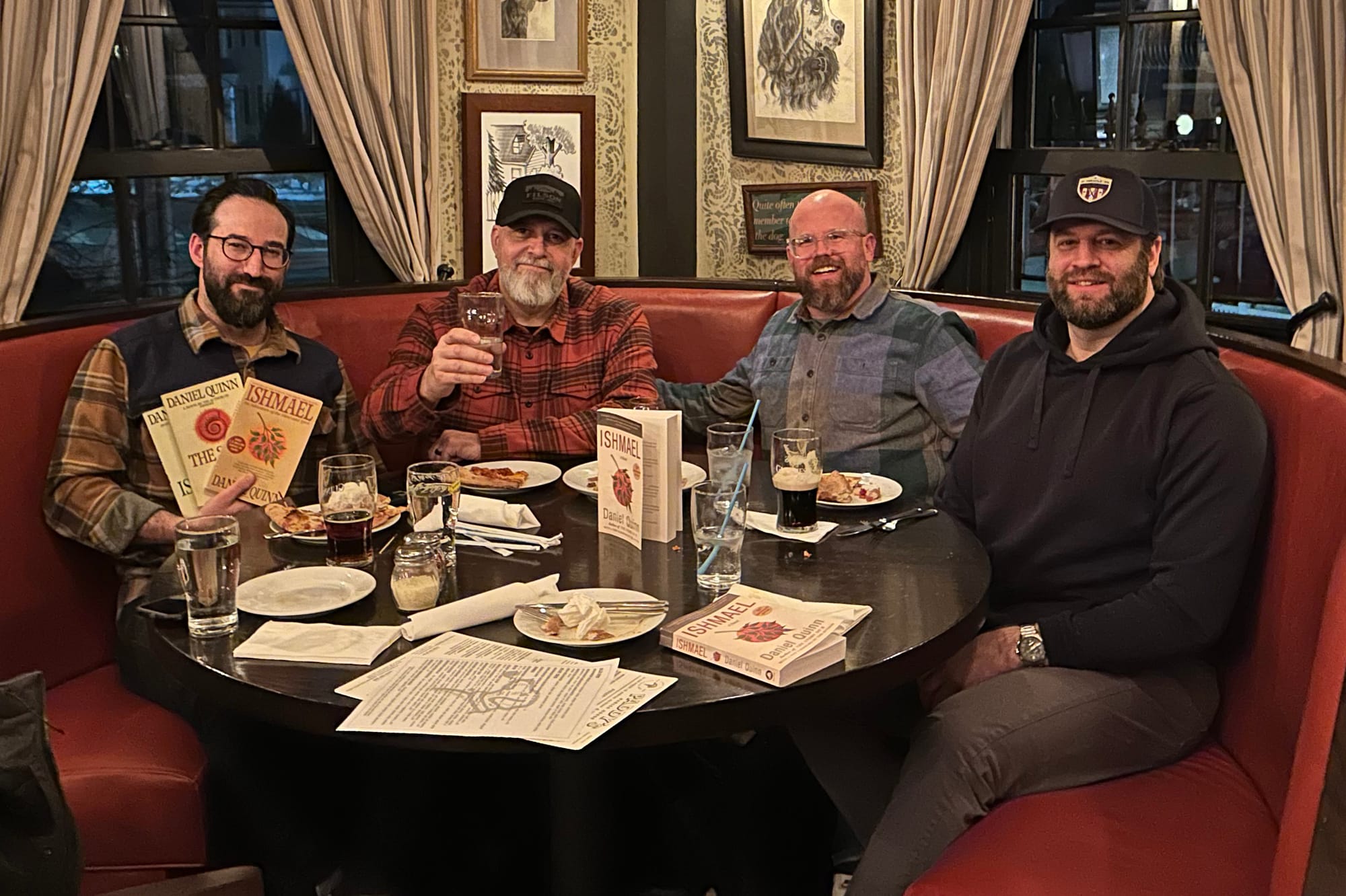
Last month, we sat down with Daniel Quinn's Ishmael — a book about a telepathic gorilla who teaches a man to question everything he blindly accepts about civilization and progress, especially the story of how we, humans, got to the present moment. If that sounds strange, it is. It also led to an amazing conversation.
We all hooked onto the idea, ever-present in Ishmael, that storytelling has a powerful grip on our culture and society, shaping the ideals and goals we strive for as modern men.
The central philosophical argument of the book is that our culture runs on a story that's been passed down — and broadly accepted — over the past 10,000 years, which may not be accurate.
Spending a couple of hours over some pizza and a few Guinness (and Guinness 0) to dig into the story of man's dominion over the world led to some unique takes. Some pushed back on the premises uncovered. Some found it all clarifying. Everyone left thinking. Goal achieved.
These are the conversations that make this worth doing. We selected Vigil as our March read, and I think it will push us in equally interesting directions.
On Doing the Hard Things
Every St. Patrick's Day, I pick up James Joyce's enigmatic classic, Finnegans Wake. I read with the fervor of someone setting out on an exciting adventure. Every year, I fail at the endeavor, making only twenty or so pages into the work. And every year, I think the attempt is exactly the point.
I picked it up again this morning. If you've ever opened a copy of the book, you know what lies ahead. This book defeats me — reliably, almost ritually — every March. There's something fitting, I've come to think, about a lover of language sitting down with Joyce each year and falling into a mind-numbing trance right off the first page.
The opening line goes like this: "riverrun, past Eve and Adam's, from swerve of shore to bend of bay, brings us by a commodius vicus of recirculation back to Howth Castle and Environs." It is beautiful. It is baffling. Within four pages, I don't know if I'm reading English or something else entirely — a dream-like literary labor that literally (although I don't know this from experience) circles back upon itself.
And yet I keep coming back. Not because I believe I'll crack it this time. But because I've come to believe that the attempt is itself the thing. Being decisive, even in the face of a seemingly impossible challenge, is essentially a part of being a good man. Push. Fail. Learn. Grow. Share. Evolve.
Joyce isn't the only opportunity to face hard things — I am halfway through a couple of years' worth of reading both Tolstoy's War and Peace and the Oppenheimer biography, American Prometheus. But in life, there are also the ever-present challenges of being a good dad, fears of failing as a provider, years of career and work woes, doubts of skills possessed or abilities wielded, and the related shame, anxiety, stress, and fear. Oh, and trying to figure out how to juggle and maybe even run a self-operated business or two.
We face up to hard things every day. Adding more challenges, like the yearly ambition to face off with Joyce, makes you realize that hard things exist for everyone. No one ever cracked open Finnegans Wake and went, "Yup! I totally get it!" Struggle. Get stronger. Move forward.
The Men Who Kept Going
As always, I love looking to the literary world, especially those who, with the benefit of time, we uphold as heroes, but who, with closer inspection, mirror the daily fights we all face in our own lives.
Consider Herman Melville, for one. He wrote Moby Dick as an attempt to achieve his closely held literary ambitions. It failed miserably. The critics were lukewarm. The public didn't read it. The book he poured everything into was, by any external measure, a disaster. But Melville kept writing anyway — obscure, unknown, poor — until his death. It was only decades after he died that Melville's willingness to attempt something enormous — and to keep working after it failed, with Bartleby, Billy Budd, etc... — became apparent. Today, he is a giant of American literature.
I love the story of Dante, who wrote The Divine Comedy while in exile. He wrote his most ambitious work, one of the greatest in all of literature, as a failure with no audience, no patron, and no home. His muse, the "love of his life," a woman he follows to Hell and back, he likely only admired from a distance. He kept going anyway. He is now though of as Italy's greatest poet.
And then there's another hard-to-grapple-with Irishman, Samuel Beckett. The playwright wrote in two languages — French and English — to purposely make the work harder for himself. His plays find characters at ease in garbage cans, buried up to their necks in sand, and trapped them in a single room waiting for someone who never arrives. And yet, audiences and readers got it. The challenge of the absurd was more truthful than anything they had engaged with artistically, even if it took a while to "get it." For Beckett, fail better was the point.
As he wrote, "Ever tried. Ever failed. No matter. Try again. Fail again. Fail better."
And there are scores of other great men who never knew if their work would matter. Several of them died without knowing. What they embraced was the challenge of the work itself — in the end, they are all the kind of men who embraced and loved the adventure of doing hard things.
Why Hard Things Matter
What unites all of these men is not genius or talent alone. It is the willingness to take on something that resists them. The willingness to be humbled and to keep doing the work for the love of it all.
This, I'd argue, is why we read difficult books together. Not to impress anyone. But because sitting with something genuinely hard — a book, a question, an uncomfortable idea — and staying with it allows us to grow.
Which brings me to this month's Book Club read, Vigil. At under 200 pages, it doesn't look hard. But Saunders's use of language asks a good deal of us as readers. I had my wife and daughter read his two-page short story, "Sticks," the other day, just to marvel at how someone could tell a powerful story so succinctly.
Vigil allows us to examine a human in the wreckage of a life lived, by his own measure, successfully, yet to a greater degree, very badly. There is no comfort in the parable of K.J. Boone. But it is exactly the task a group of men striving to be better in their own ways wants to wrestle with on a Wednesday night in March.
I'll see you there. Maybe I can recount what happens in the first five pages of Finnegans Wake for you.
A "Finnegan's Wake" Language Lesson
A quick aside.
According to one of the recorded introductions to the Irish song "Finnegan's Wake," by the Clancy Brothers, Joyce was inspired by the American-Irish street ballad to write his epic, erudite novel.
The song tells a quick story of a laborer who falls from a ladder, dies (everyone thinks), and is then brought back to life when whisky (from the Gaelic, "uisce beatha," "the water of life") is spilled on him during his riotous Irish wake.Obviously, the song stuck with Joyce and pushed him to create the epic language maze of Finnegans Wake.
For me, too, there is something magical about the words of this song.
It is a life goal to somehow use all of them in writing someday. Words like "ruction," which means a fight, "bedad," which means shock, and phrasing like "belt in the gob," "punched in the mouth," sound so great in song; it's no wonder Joyce was inspired by the street ballad.
Here's a favorite version for context:
The Gentleman Shares - Recent Thought-Provoking Reading and More
A few things worth your time this week:
Why Read the Classic Books? An Interview with Naomi Kanakia, The Honest Broker podcast
I came across this interview, and it is fascinating. It might lead you down a wisdom wormhole in which you discover classics beyond what might be called the Western Canon, including legends from China and Japan.
The premise, too, challenges accepted wisdom.
Is ‘Wuthering Heights’ Actually the Greatest Love Story of All Time? - A.O. Scott, The New York Times
I haven't seen the recent film adaption yet, which has received a range of reviews, but I did read/listen to Emily Brontës story for the first time recently, and, think it is more a tale to teach the lesson many of us men, and especially young men, need to understand: "Here's what a terrible man looks like. Don't be this guy."
Here is A.O. Scott's take. With the Oscars this week, I'd be remiss if I didn't also point out that I thought all of the top-nominated films this year — "One Battle After Another," "Sinners," "Hamnet," and "If I Had Legs, I'd Kick You" — were outstanding. "One Battle After Another," in particular, wowed me. P.T. Anderson based the film on Pynchon's Vineland, a book I've had a long, complicated relationship with, and seeing it rendered on screen was its own kind of reward.
"The Irish Rover" - The Dubliners and The Pogues
I have to finish off with another classic that is best enjoyed with a cold Guinness.
An Ask to Help The Wild Gentleman
Keep sharing ideas, book recommendations, blog topics, and feedback.
The community we're building depends on thoughtful people willing to engage deeply. If that describes you (and I think it does), help us grow. I'm in the midst of figuring out how to get more folks to support and serve as patrons of this endeavor.
Any ideas are appreciated. I have a few about growing this little project. If you want to be a patron, I am forever grateful to you!
Keep reading and keep showing up for the people and things that matter.
Wild at Heart. Refined in Mind.
Dennis