Cannery Row: A Reader's Guide

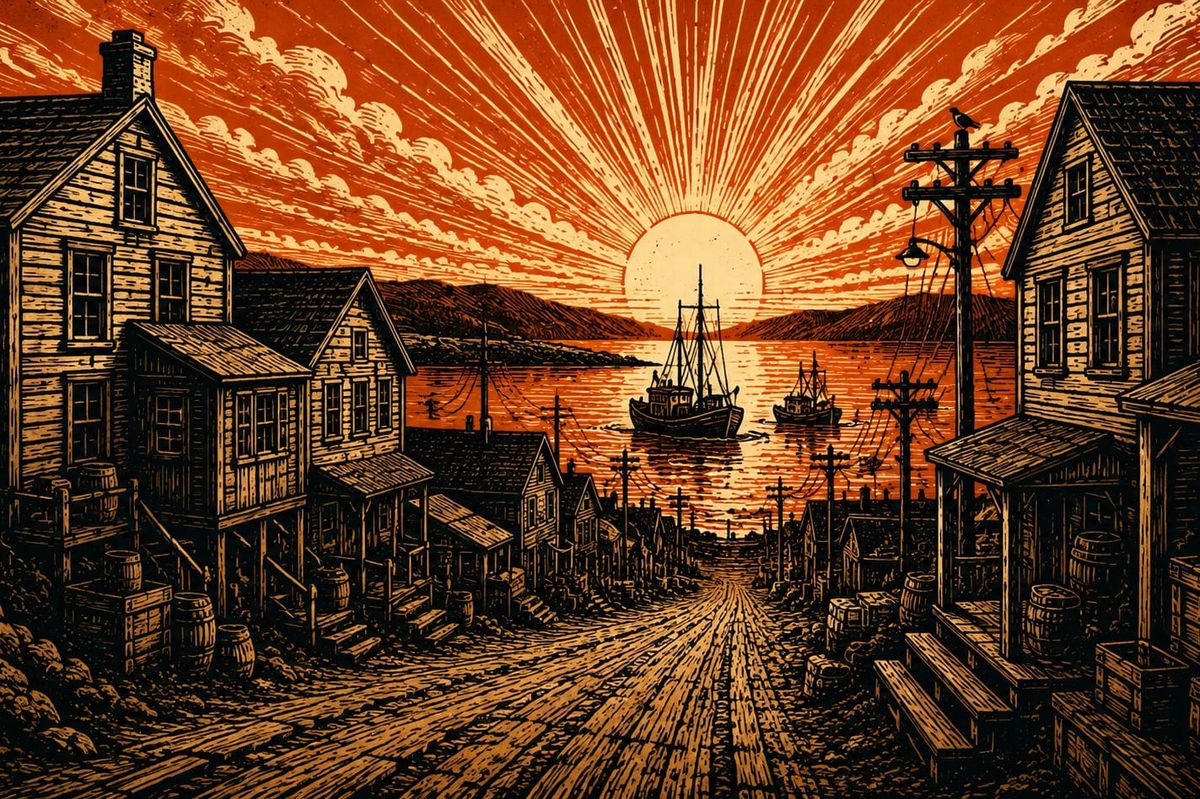
Meeting #12 - Tuesday, July 21, 2026
"Cannery Row in Monterey in California is a poem, a stink, a grating noise, a quality of light, a tone, a habit, a nostalgia, a dream." — John Steinbeck, Cannery Row
The Wild Gentleman Book Club
Last month, we met with a small crew and chatted about Niall Williams's book, John.
It was a good, deep discussion about a book centered on a well-known Christian figure but using that figure and his story to examine aging, memory, mentorship, community, and loyalty. I also took a lot away from the rich and well-written book about how vital experience is in being able to create something worth enduring a life's worth of challenges for.
Cannery Row Meeting Details
Tuesday, July 21st, 2026, we are convening upstairs at 6:00 PM at Paddy's Public House in West Newton.
If you haven't come to a meeting in a while or haven't come at all, come and see what it's all about. Even if you didn't read the book, come for the company and good conversation.
This month's book, John Steinbeck's Cannery Row, is short, funny, and sneakily one of the best books ever written about what it means to be a good man in a place that doesn't reward it. It's also a great listen on Audible or Spotify.
Please join us. You can find more information and RSVP here: The Wild Gentleman Book Club - Meeting #12.
You can also get a printable version of this reading guide here: Printable Reading Guide.
Lessons Steinbeck's Cannery Row Can Teach Men in 2026?
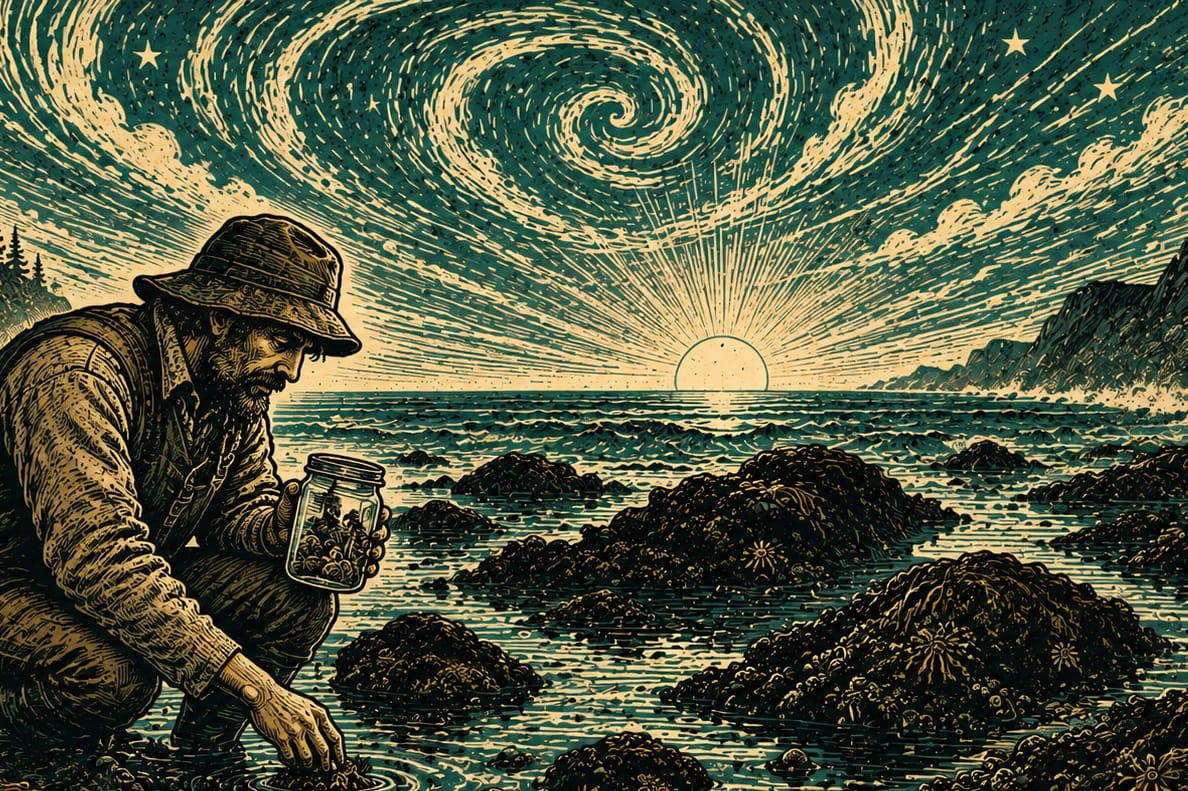
Doc doesn't announce himself. He's just there — waders on, tide pools at dawn, hauling creatures back to Western Biological. He runs a one-man business, seemingly on the razor's edge of failure and somehow keeps the whole street standing. He feeds Mack and the boys when they've got nothing. He looks after Dora's girls and Lee Chong and half the drifters on the Row without ever calling it charity. Most of all, he listens — actually listens — in a place full of men who've stopped expecting that simple kindness.
And when the boys of Cannery Row decide to throw him a party, it isn't for anything he did once. It's for everything he's done in his life.
That's the book: A man builds a life around self-sufficiency and quiet generosity, and his community recognizes and wants to say thanks. Steinbeck spends two hundred pages proving that just showing up — consistently, for people who can't do anything for you — is its own kind of magnetism.
That's the lesson worth sitting with in 2026. Even with a busy life, he has time for the real folks who just need a little time to feel rich. He has time for Frankie. He has time for a beer with Mack when Mack has nothing else to offer him. Most of us don't run on tides. We run on inboxes, and we've decided that's just what adulthood costs. Doc's whole life argues otherwise — not because he's idle, he works constantly, but because he never lets the work crowd out the noticing.
One thing worth knowing that amazed me as I researched this book: Doc is not entirely fiction. Steinbeck built him from a real-life friend, mentor, and co-author, Ed Ricketts, a marine biologist who ran an actual lab on the actual Cannery Row. Steinbeck later called him one of the two or three men who most shaped how he saw the world. So the drinking, the women, the generosity, the tide-pool wisdom — none of it is invented. Steinbeck wasn't building an ideal. He was describing a friend and a good man.
Discussion Guide
Key Themes to Consider
1. Doc as the Model of the Good Man
Doc doesn't lecture or judge or try to change anyone. He runs his lab, does his work, and treats every person on Cannery Row — the vagabonds, the working girls, the local boys and transients — as individuals with unique worth. In living his life by his own terms, he garners respect and creates goodwill among all whom he comes in contact with, so that they feel compelled to show their appreciation via not one, but two parties in his honor. It's a thank you for years of showing up as a good man.
Questions to Explore:
- What specifically does Doc do that earns this kind of loyalty? Is it any one act, or is it the accumulation of small, unglamorous ones?
- Doc never seems to be performing goodness — he's not doing it to be seen as good. Does that matter?
- Self-sufficiency shows up again and again in Doc's character — his business, his solitude, his refusal to need much. Is that self-sufficiency the source of his generosity, or in tension with it?
- Who is the Doc in your own life — the person who shows up consistently, asks for nothing, and probably doesn't know how much he's appreciated? Maybe tell him?
2. A Good Man for His Era?
Doc drinks heavily. He moves through relationships with women in a way the book treats nonchalantly, but might be viewed as careless to a modern reader. He's also, by the standards of Depression-era Cannery Row, remarkably decent — faithful to his friends, generous with his money and time, gentle with people everyone else had given up on.
Questions to Explore:
- Is it fair to hold Doc to a modern standard of how a good man acts, or does that change the book entirely?
- Steinbeck doesn't moralize about Doc's drinking or his women. Is that an endorsement, an oversight, or just honest reporting of the world as Steinbeck knew it and tried to capture?
- Doc was modeled on Ed Ricketts, a real man Steinbeck knew, worked with, and had great admiration for. Does knowing Doc is drawn from an actual friendship change how generously you read his flaws? Should it?
- Can a man be genuinely good — generous, present, loyal — while also carrying habits we'd now call self-destructive or potentially harmful to those around him? There are a few characters, beyond Doc, that fall into this category. How should we perceive them all?
3. The Hard Parts of the Book
Cannery Row was written in 1945 about a town in the 1930s, and it carries the casual racism and misogyny of both periods — the caricature of Lee Chong, the way women largely exist in the book as objects of desire or figures of comedy, rarely as full people with interior lives. Should this matter?
Questions to Explore:
- How do you read a book you admire and that is beautifully written — when parts of it are genuinely uncomfortable? Do you separate the craft from the attitudes of the time?
- Whose story does Steinbeck actually tell in this book, and whose does he leave flat? What would Cannery Row look like told from Dora's perspective, or Lee Chong's?
- What do we do with books like this as fathers, as men trying to pass along a reading life to the next generation? Do we hand them over with caveats, wait until kids are older, or trust readers to have the maturity to understand nuance?
4. A Book That Just Comes to Be
Steinbeck opens Cannery Row by comparing the writing of it to collecting delicate marine animals: "you must let them ooze and crawl of their own will onto a knife blade... and perhaps that might be the way to write this book — to open the page and let the stories crawl in by themselves." The result is a novel that can meander — chapters on the town giving way to entire interludes about a gopher, or boys teasing one another, or a fantastic figure who seems unreal, before returning to the main plot.
Questions to Explore:
- Does Steinbeck's stated approach — let the stories crawl in on their own — earn the loose structure of the book, or is it a clever excuse for a novel that doesn't quite hang together? Did you find the interludes to work or distract?
- Steinbeck seems to be arguing that attention to a place and its people is itself a kind of story. Do you buy that? What would it mean to pay that kind of attention to your own neighborhood?
Passages That Stuck with Me
On Henri and the unfinished boat:
"He likes boats," said Doc. "But suppose he finishes his boat. Once it's finished, people will say, 'Why don't you put it in the water?' Then if he puts it in the water, he'll have to go out in it, and he hates water. So you see, he never finishes the boat — so he doesn't ever have to launch it."
Every man building something he never quite ships should sit with this one for a minute.
A little facial hair humor:
"A man with a beard is always a little suspect anyway. You couldn't say you wore a beard because you liked a beard."
On Doc's road trip:
"Because he loved true things he tried to explain."
One line, and you understand exactly why everyone on Cannery Row trusts this man.
On Mack and the boys, from Doc's perspective:
"There are your true philosophers. I think... they survive in this particular world better than other people. In a time when people tear themselves to pieces with ambition and nervousness and covetousness, they are relaxed."
On success and the things we love: "
It has always seemed strange to me... The things we admire in men, kindness and generosity, openness, honesty, understanding and feeling are the concomitants of failure in our system. And those traits we detest, sharpness, greed, acquisitiveness, meanness, egotism and self-interest are the traits of success. And while men admire the quality of the first they love the produce of the second."
Doc says this almost in passing. It's the thesis of the whole book, and possibly the thesis of The Wild Gentleman.
On guilt and misfortune:
"People in their black minds remember sins committed secretly and wonder whether they have caused the evil sequence."
Steinbeck, in one line, on why bad luck always feels like it must be our fault.
Looking Ahead
For August's TWG meeting, we'll be reading Charles Portis's True Grit.
RSVP here if you plan to come: https://luma.com/tpw9tpxo
We'll keep chasing these same questions — about goodness, about how a man carries himself even when he doubts himself, and about what it costs to actually live by your own code.
Please share any suggestions: dennis@thewildgentleman.com
Final Thoughts
Steinbeck never pretends Cannery Row is a simple place or that Doc is a simple man. He lays out the beauty and the ugliness of a real street full of real people, and lets the reader judge their value.
It is a very honest way to tell a story — and about the man it's built on. Ed Ricketts was, by every account, exactly as complicated as Doc: Brilliant, generous, undisciplined, beloved, tragic. Steinbeck paid attention to him, the same way Doc pays attention to everyone on the Row.
That's the whole ask this month. Not to decide once and for all whether Doc measures up to our standards of masculinity and being a good man. Just to recognize him — and the men in our own lives doing the same quiet work — and appreciate their worth.
The Wild Gentleman Book Club
Where thoughtful men gather to explore literature, meaning, and authentic masculinity.
Wild at Heart. Refined in Mind.