Newsletter #14 - Get Outside

Updates
The Wild Gentleman Book Club met on Wednesday, August 12th.
Over the summer, we met and discussed John by Niall Williams, Nick Offerman's Where the Deer and the Antelope Play, and John Steinbeck's Cannery Row.
In August, we read Charles Portis's True Grit — you've probably seen one, or both, of the movies, but the book hits a bit differently. Short, funny, and only a couple hundred pages, this is the perfect book to wrap up our summer of reading.
You can listen to True Grit on both Audible and Spotify.
The Wild Gentleman Book Club
Wednesday, August 12th at 6:00 PM
Paddy's Public House in West Newton
RSVP: https://luma.com/tpw9tpxo
Questions? Reach me at dennis@thewildgentleman.com.
Read on.
The Wild Gentleman in July
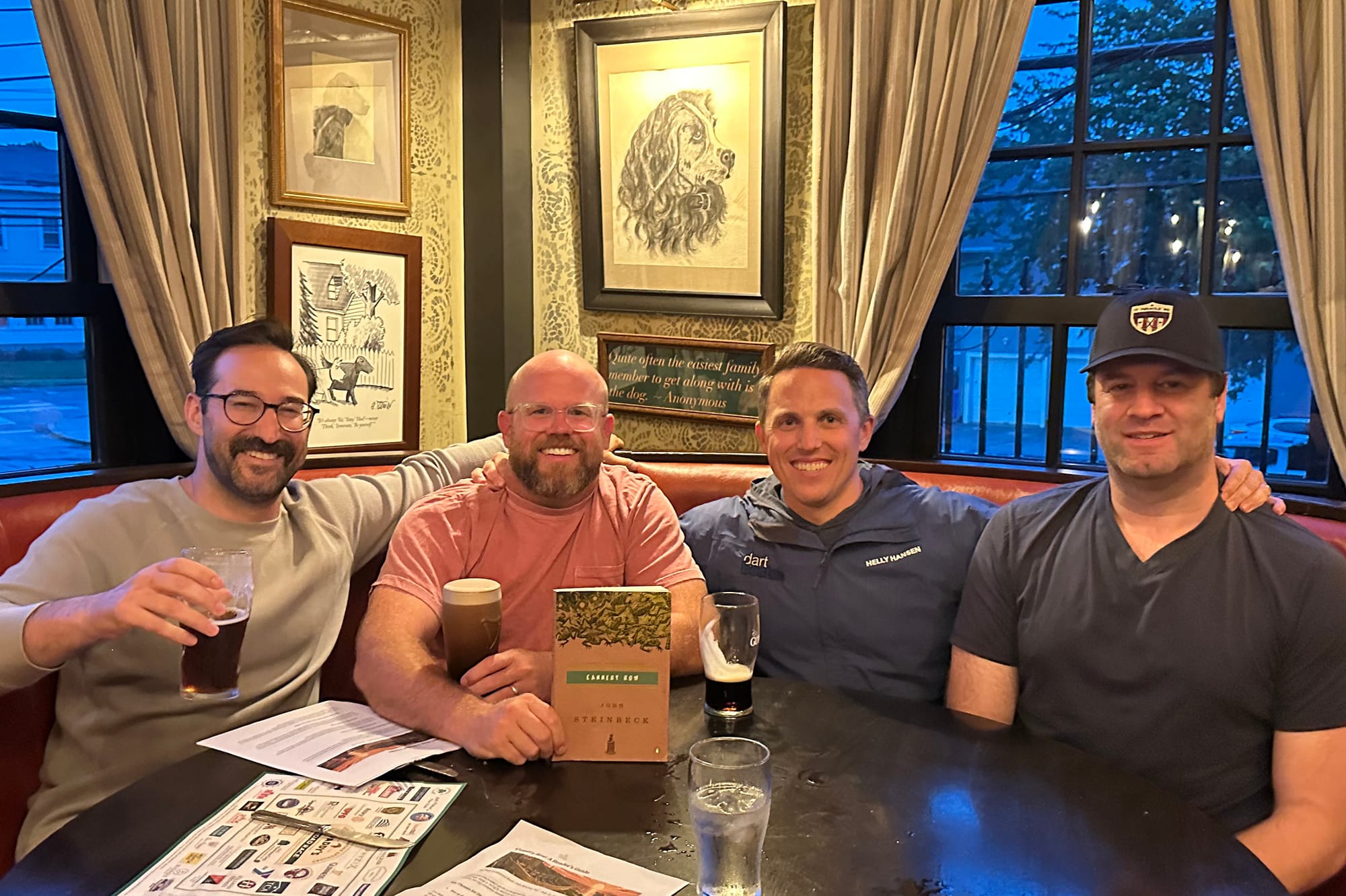
In July, we let the characters of Steinbeck's Cannery Row — Mack and the boys, Doc, and the other folks of waterfront Monterey who'd quietly opted out of the chase — lead the discussion.
One thing we all noted was the unusual format of Steinbeck's book, which, some of us thought, made it hard to "get into" the story. Cannery Row alternates between a narrative about a crew of vagabonds trying to celebrate the nicest guy they know — neighborhood marine scientist Doc — and Steinbeck's character and setting portraits of the Monterey waterfront.
We were all attracted to the easygoing way of life that all the central figures in Cannery Row embody, which led to talk of career, life responsibilities, and the need to slow down sometimes. Good stuff.
You can check out the Cannery Row Reader's Guide here for more.
The Wild Gentleman Summer 2026
Charles Portis's True Grit.
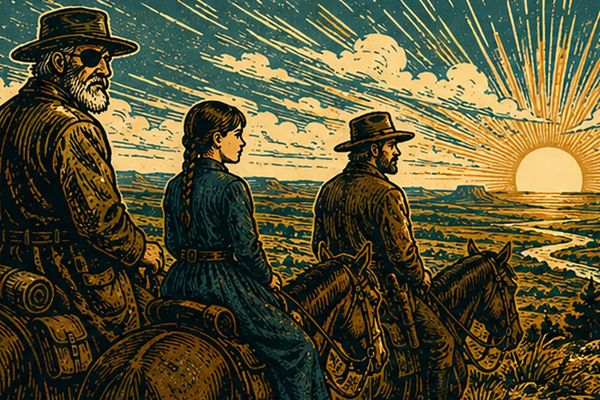
Told from the perspective of Mattie Ross, the book is a sharp, adventure-packed look back at her adventure as a fourteen-year-old following a drunk, one-eyed federal marshal and a former Texas ranger into Indian Territory to hunt down the man who killed her father. The narrator, Mattie, comes off as the truly grittiest character in a book filled with hard men like Rooster Cogburn, bands of outlaws, and a few dangerous creatures.
While vengeance and justice are at its center, True Grit is more a book about the cost to see something through — dedication to a cause or belief, when everyone around you would rather you let it go.
Get your copy of True Grit on Bookshop.org →
Any ideas for the next books we should read? Send them my way: dennis@thewildgentleman.com.
Touch Some Grass
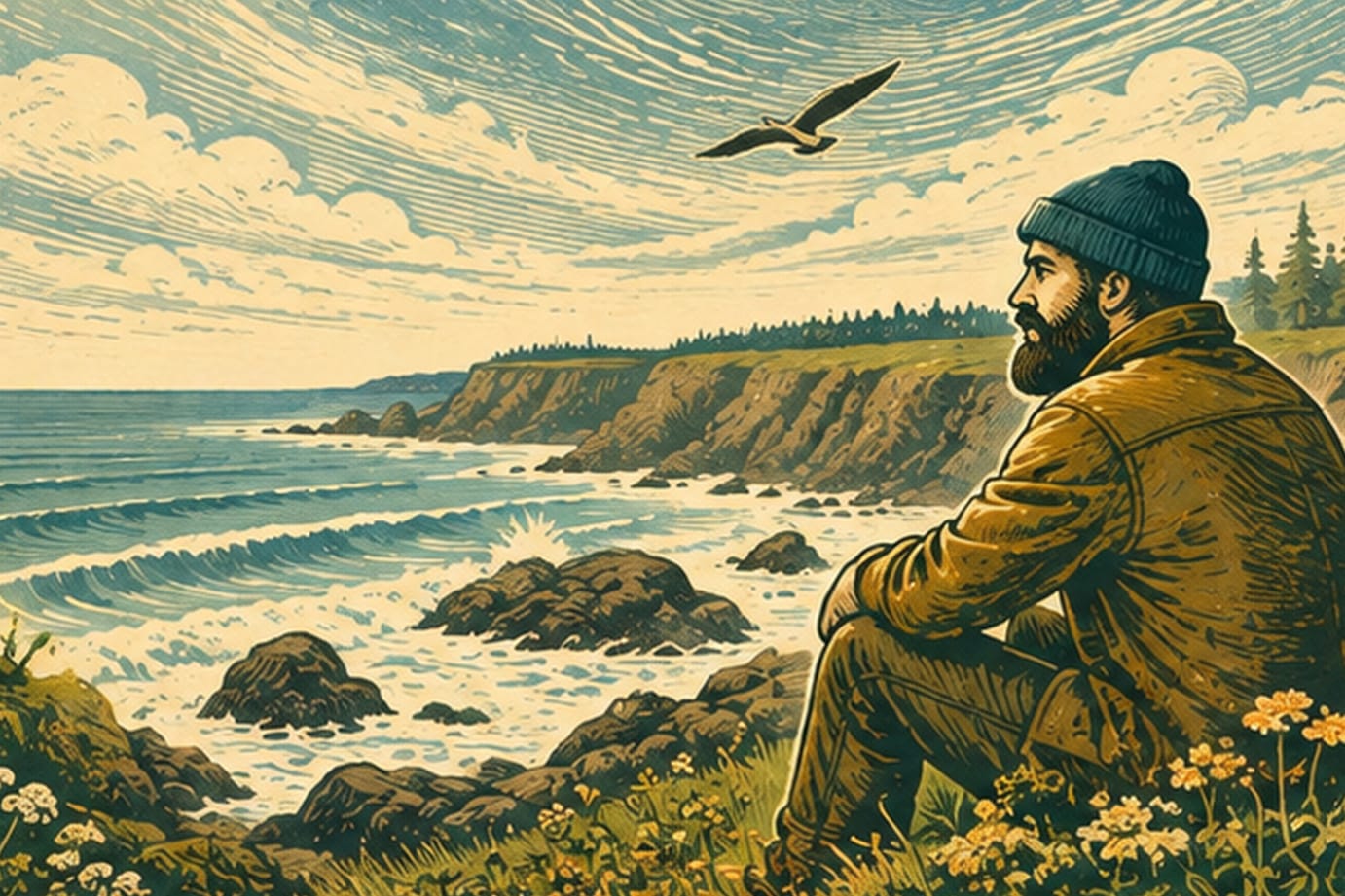
As I sit here writing, on my back porch, with the continual music of crickets and blue jays, the sights of ivy-covered pine trees and the late evening summer sun, I am thinking back fondly to the sounds, smells, sights, and sensations of the last couple of weeks spent — on and off, with some return interludes in the Boston-area — in Maine.
I actually was in Maine the other morning, waking up to the still waters of one of its many lakes, heading home with my daughter down a dust-filled dirt road, smelling the pine as we buzzed by, on the lookout for the oft-sighted local doe and her fawns. I had pretty much decided the other night, at around 5 PM, to drive, with my basketball-camp-dedicated daughter, back up to where the other half of my family has been for the past few weeks, mainly, no pun intended, to just get there and jump in the refreshing lake. Such was the heat and humidity at home, outside Boston.
Did it take up multiple hours of driving during which time I could have been writing and publishing this newsletter?
It did.
And it was so worth it.
In the past month, I have driven over the Piscataqua River from Portsmouth, New Hampshire into Maine more than a half dozen times. Each time, there is a feeling — ease? welcome? grounding? — that I sense crossing into a place larger, wilder, and more open (and tree-filled) than where I just left.
I get the same sensation crossing from Hanover, New Hampshire into Vermont, driving past the exit for 84 West (headed not, as is common, towards Hartford and New York City, but that indistinct unknown we call "Western Mass"), or, as I've been lucky a few times in my life, to come out the other end of the I-80 tunnel in Colorado and into "the mountains."
I don't know if something within us (or me, specifically) is sparked by being outdoors, closer to a wildness we might not be able to fathom. But it is a balm, definitely. And it is something I, at least, yearn for while stuck in traffic or sitting inside some indiscriminate glass/concrete/steel commercial building.
Looking back over a summer of reading, nature was an ever-present theme. Nick Offerman's outdoor hijinks, the ancient-era unwieldy Mediterranean Sea and unwelcoming coast of John, the consistently there-in-the-background role the Pacific Ocean plays in Cannery Row, and the always metaphorical/literal Wilderness that is antagonist and savior in nearly every "western" novel, including this month's read.
This month it's the tale of Mattie Ross, Rooster Cogburn, and LaBoeuf, tracking wanted men in the region known as "Indian Territory," that tract of wildness that makes an appearance in a lot of American westerns that we know as modern-day Oklahoma. Filled with plains, grasslands, hollows, mountains, rivers, and more, the setting elicits a definitive feeling that the characters are definitely not in the civilized world.
As I read, I couldn't help but think two things at once. One, there is a definite danger in this wilderness; the land and its unknown risks and creatures pose a constant threat to life, especially if you are unfamiliar or inexperienced. Second, those with experience and familiarity possess a gift of understanding of (or are at least more attuned to) the world they inhabit.
They travel by landmark and compass direction. They know the secret hiding and resting places. They manage to (drunkenly) overshoot their destination and end up closer than they imagined to a deep woods hideout.
What characters like Rooster Cogburn possess, both a respect for the natural world and an intuitive sense of how to operate within it, is something in rare supply these days.
I certainly don't possess much of that grit, as you might call it, as it relates to the outdoors. And, to be honest, I consider myself a bit more active outside than your typical American. Do I have the skills to hike the Appalachian Trail or sail the Atlantic coast? Absolutely not. Can I steer a sailboat at a landmark and "sail" for a few hours? Sure. Do I know the local running trails well enough to take a road less traveled now and again? Yup. Have I slept in a tent more than once this year and bathed in a lake? Uh-huh. I've swum in open water for thirty minutes, walked for hours in woods, kayaked, skied, adventured.
But I am not in tune with nature even the slightest degree as the generations that set off into the unknown American West were.
There is something really impactful about being outdoors. I feel great if I am within five miles of a National Park entrance sign. There is so much you can gain from seeing places like Moab, Crested Butte, the Arizona desert, Lake Tahoe, the Teton Wilderness, Plum Island, and The Long Trail. But I don't have the confidence or clarity of my surroundings to feel I could survive any amount of time out in those places.
But I do love to share these places and hope to do more and more.
The closest I can get to this knowledge is through reading and being awed by fictional characters who wield power over their realms. But even then, I cannot possess that wisdom. Nor can I pass it on.
I can get close. Mark Twain's Mississippi River. Cormac McCarthy's Mexican border towns. Thomas Pynchon's fantastical South Africa, northern California, and colonial mid-Atlantic. Steinbeck's Salinas Valley. Homer's Greece. Tolstoy's Russia.
Just take Mark Twain's two most famous characters. Tom Sawyer is the boy raised on books. He has knowledge of how adventures are supposed to go, according to people who wrote about them. And sometimes they don't.
Luckily, he has Huck. Raised on the river and nearly illiterate. What he knows, he knows because he had to: How to read the current, how to tell a coming storm from a passing one, how to survive a night alone on an island with nothing but what he's carrying. When things in Twain's stories go wrong, and stakes are real, the one with the power to get out alive isn't the imagination-filled Tom. It's Huck.
And yet. Tom knew a hell of a lot more about navigating his surroundings — islands, river, caves — than most folks know about their own neighborhood today.
As a dad who wants to be a mentor, I want to pass down knowledge to my son (and I think a lot of men should share their wisdom with younger generations more than we currently do, but that's a conversation for another day).
Like me, he can gain knowledge from what he reads and what he's told — information useful and necessary, the foundation of most of what he'll need. But there's the other kind of knowing, the kind that only shows up when you're outside long enough to get a little lost, a little cold, a little unsure of the way back, and you need to work it out with your own eyes and your own feet. And that is hard for me to offer and for him to undertake on his own.
Not so for Mattie Ross, who has a wealth of learned and innate wisdom. She can quote scripture and cite contract law to grown men twice her age. But the knowledge that actually gets her through Indian Territory — how to read a river crossing, how to sit a horse for three days straight, how to survive a night in a pit with a corpse and a rattlesnake for company — none of that came from a book. It came from being out there. Rooster's grit is the same species. It isn't clever. It isn't literary. It's the plain, earned competence of a man who has been outside, in trouble, more times than he can count, and simply knows what to do next.
We don't raise many boys (or girls) to become figures like Mattie Ross or Rooster Cogburn. The world I'm handing my son is almost entirely indoors and almost entirely mediated: read about it, watch it, ask an app. That's not nothing. It's most of what he'll need for most of his life. But there's a kind of confidence that doesn't come from any of that, and I think it's the one Twain argued for and the one Portis gives to a fourteen-year-old girl who has no business having it yet — the confidence of a person who has been out there, alone or nearly alone, and found their own way back.
So what to do? I will never set off to hunt down a vagabond in uncharted country with a whole host of danger lurking around each bend. Nor will my son or daughters.
But. We can still appreciate any time we have outside. Especially with each other.
Take that impulsive drive just to dip into some cold water. Drift off the trail a bit. Spend more time outdoors than in for a day. Sleep under the stars.
You may not gain the confidence of a Rooster Cogburn or Huck Finn, but you will gain something. You will be closer to something real, something dangerous, something beautiful. Imbibe.
Touch some grass.
The Gentleman Shares - Recent Thought-Provoking Reading and More
A few things worth your time:
Cheap beer and a suspect blocker: Before Mark Carney was Canada’s prime minister, he was Harvard’s No. 3 goalie - Fluto Shinzawa, The Athletic
Here is something I did not know. Canada's prime minister spent his formative days playing hockey in Cambridge and running with a ragtag (yet Ivy League-credentialed) crew of hockey guys in and around Harvard Yard.
Friendship Is I Love You, Man for the A24 Generation - Dana Stevens, Slate
This film might have flown under your radar, but it is worth (maybe?) an uncomfortable watch. Starring Tim Robinson and Paul Rudd — two actors/comedians with very unique and, I might say, cynical performance styles — the film is the embodiment of all the nightmares we have about making friends as guys in mid-life. This is a very dark comedy.
“Tony,” “Late Fame,” and the Rocky Road to Literary Stardom - Justin Chang, The New Yorker
In another film review, The New Yorker breaks down the newly released Anthony Bourdain, Provincetown-centered biopic and Willem Dafoe's turn as a washed-up poet — both seem like must-see films.
Support The Wild Gentleman
There was an update to the membership tiers.
The best way to support The Wild Gentleman is to become a paid member, which gives you access to the full archive of printable reader's guides, comments on every post, and more in the future.
There are also some opportunities to really help and be a patron. Reach out if you want to find out more.
For all of you who already support The Wild Gentleman: Thank you. I am forever grateful.
Wild at Heart. Refined in Mind.
Dennis