Stoner - A Reader's Guide

Meeting #16 - Tuesday, November 17, 2026
The Wild Gentleman Book Club
In October, we discussed one of the more challenging books we've read thus far in Wendell Berry's The Unsettling of America. Our first foray into non-fiction, Berry's collection of essays touches on the essential role that the natural world, relationships, and farming play in what we consider American culture. The argument is that we must not let greed and a worship of progress make us forget our roots as a nation, built upon connections to the land and each other.
Stoner Meeting Details
We had a lot of interest in our November meeting, more than we have room to host. But with our venue changing again in December (TBD) and our return to Paddy's in January, we should be able to welcome all who want to come.
(Because we had to create a waitlist for this month, I may host a Thanksgiving week coffee meetup on Tuesday or Wednesday to discuss the past few months of books for those who haven't been able to attend our night outings — if interested, shoot me an email at dennis@thewildgentleman.com.)
This month's book is John Williams's Stoner. This book had been recommended to me a few times, and it did not disappoint. It is one of my favorite books I've read in a long time. You can also listen to Stoner on Audible or Spotify.
Want a printable version of this reading guide? Go here: Printable Reading Guide.
What Stoner Teaches Men
Stoner is a very even-keeled book. Williams tells this story — that of a Missouri farm boy turned lifelong English professor — steadily yet with restrained tension. It has numerous calculated risks but more missed opportunities. Throughout, there is something for Stoner to fight for and a challenge to fight against. And in the end, it is a mystery whether he does either purposely or even at all.
Stoner is the hero's journey tested against the customs, conventions, and expectations of the Midwest, American exceptionalism, and the norms of the twentieth century. Yet this Odysseus has no Ithaca. He is continuously unmoored.
He follows the path set out for him: learn, teach, build a career, marry, raise a child. None of it goes by the book. And yet it makes absolute sense that it doesn't.
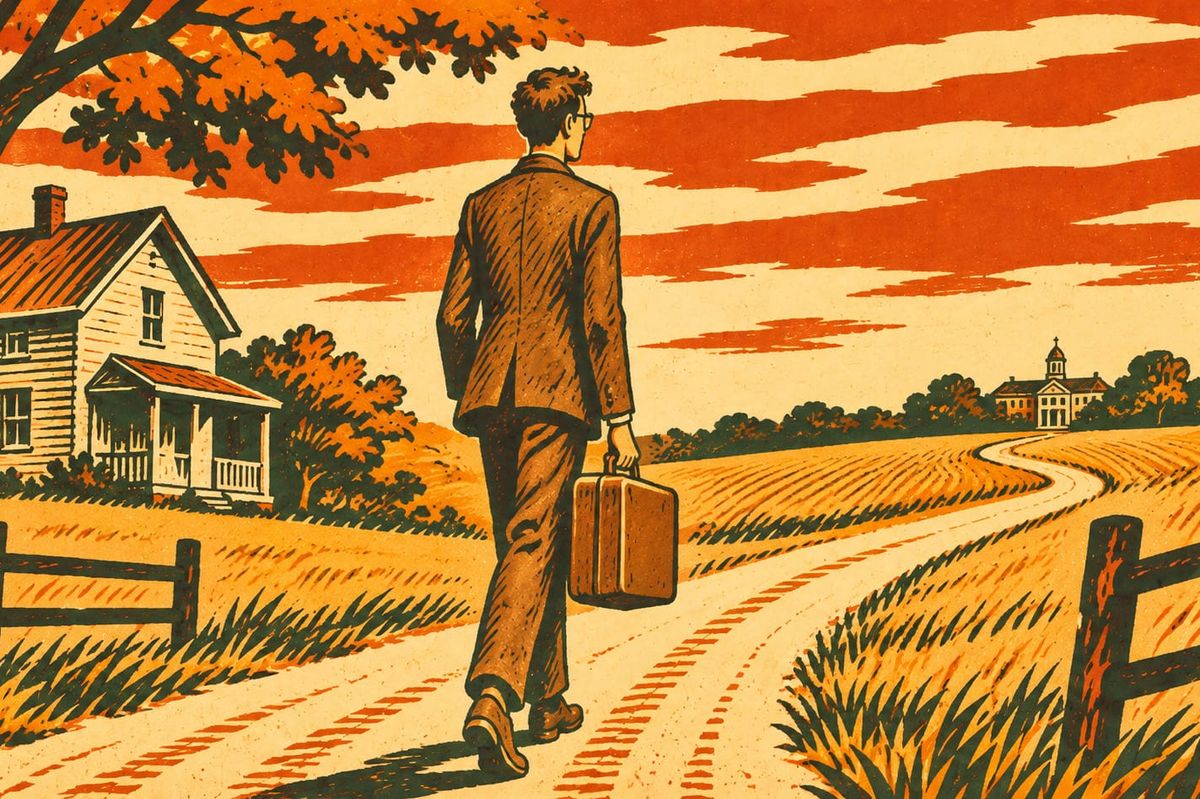
I read him as an exemplary American man. He is at home in the pantheon of characters in the mold of Steinbeck's wharf rats, the cocksure Westerners of Portis and McCarthy, even George Saunders's Abraham Lincoln. And yet as those men stumble into adventure, ride out into the wilderness, or embrace their destiny, Stoner stays put at the university not more than 40 miles from his home. For this man, the frontier ends up being the English department.
In the end, I was left with a deep appreciation for the story and for Stoner. Although he lives a life without any great victories or lasting love, with one true friend and a lifelong enemy, and a legacy he professes to be unremarkable, there is a powerful beauty and simple comfort in experiencing Stoner's journey through this life.
Lastly, I can't help but wonder how much his emblematic character resembled the author John Williams (1922–1994). He grew up in Texas, served in the Army Air Forces in World War II, and taught at the University of Denver for about thirty years. He also earned his Ph.D. at the University of Missouri, the same campus where Stoner spent his entire life.
Stoner came out in 1965, sold little, and went out of print. Decades later, it was reissued and became a bestseller first in Europe and then in the U.S.
A book about an overlooked life was itself overlooked.
Discussion Guide

Key Themes to Consider
1. Do What You Love
Once he gets the bug for literature and poetry, there is no other path for Stoner to take, and, with a bit of fortune, he ends up in a position to teach for the rest of his life. And that is what he realizes, later in life, that he is truly passionate about: learning something new and then imparting that wisdom to the mostly eager students who come in and out of his life at the university.
- One question in Archer Sloane’s class changes Stoner’s life. Did you ever have your own Sloane figure in your life?
- Stoner leaves the farm and a way of life that he seemed destined for. It is implied that his parents sacrificed a good deal to keep the farm operating and sent Stoner to college to support it in the future. Was his shift to literature a betrayal or actually a gift to them?
- Stoner never becomes the star professor, but he never stops loving the work and continuing to learn. In the end, was it enough for him? Would that be enough for you?
2. The Path You Are Told to Take, and the One You End Up On
School, career, marriage, family. This is the modern path, we are told, to happiness. Stoner follows this plan, for the most part, and the results are not a joyful existence. And yet, in the end, it all seems to be the only way for this man to live a life that was, in its way, good.
- Stoner does everything in what one might call the culturally prescribed order. Almost none of it turns out as expected. Does that make the book more realistic? Do you have a moment in your own life path that defied the expected script?
- How do you perceive the character of Edith? Is she living a parallel mundane life to Stoner? Is she a villain, or is she trapped by the conventions of the day, similar to Stoner?
- What do you make of Stoner's relationship with Grace? How it started and how it changed. What about its final outcome? Should he have fought harder as a father at times, and why, do you think, he didn’t?
3. Principles - The Mixed Results
A lot that goes wrong in Stoner's life seems to result from his sound moral code. Whether that's the dutiful way he marries Edith and takes her on a disastrous honeymoon — and then maneuvers around her whims thereafter. Or the purgatory that his professorship becomes once he stands on principle against Lomax. The outcomes of trying to do right make his life harder. And yet, a moment lacking "good morals" by societal standards stayed with me most: the love affair. That’s Stoner at his most natural. There, and in his fight to teach what he loves despite the departmental politics.
- A key moment, and one that will impact his career until its end, is Stoner's refusal to let Charles Walker pass. Was he right? Was it worth the retribution from Lomax?
- Stoner fights harder, more passionately, and more strategically for his teaching duties yet cedes control almost everywhere else in his life. Why teaching?
- The affair with Katherine Driscoll is a bit of a curveball, as it is the happiest we see Stoner. How do you square it with how it came to an end?
4. An American Odyssey
Stoner has adventures: a dissertation, a bad marriage, a department feud, and one love affair he can’t keep. They’re quieter than a cattle drive in Lonesome Dove or Sal and Dean tearing across Kerouac's American highways. I’m not sure they’re any less dangerous.
- Berry argued last month that we lose something when we leave the land. Stoner leaves the farm and never really goes back. Is he proof of Berry’s warning, or did he find another way to stay rooted?
- John Grady and Mattie are chasing justice, or a way of life that’s already gone. Stoner mostly endures. Is endurance its own kind of courage, or is it what we lean on and tell ourselves when we don't take action?
- Where does Stoner fit among the men we’ve read this year? Is this book an American adventure story?
Looking Ahead
Next month, December, we will be reading and discussing Denis Johnson's Train Dreams. Grab a copy from The Wild Gentleman on bookshop.org.
We are finalizing the date and location, so look out for an update soon.
Final Thoughts
Stoner never seeks admiration. Not from his own teachers, his friends, his colleagues, even his family. He shows up, does the work, loves deeply and loses, and dies mostly forgotten by the institution he gave his life to. A sad, almost boring story in that light.
But neither during nor after reading Stoner did I once think that Williams wrote a sad book. What grips you is its honesty about what most of our lives look like: no grand victories, a few people who really know us, and work we either love or don’t. Stoner loved his, and that counted most.
There’s also a lesson in the book’s own history. It sold almost nothing, went out of print, and waited 40 years for readers to find it. Some things take a long time to be seen. That doesn’t make them any less impactful.
The Wild Gentleman Book Club
Where thoughtful men gather to explore literature, meaning, and authentic masculinity.
Wild at Heart. Refined in Mind.